Gear Manufacturing#
Two philosophies: direct forming vs. kinematic generation#
Gears can be manufactured according to two fundamental principles:
Direct-form machining: A tool with the exact profile of the tooth space (or of the tooth) removes material. Conceptually simple, but every module and number of teeth requires a specific tool.
Generating machining (hobbing/shaping): The tool simulates the meshing motion with the workpiece, “generating” the involute profile through kinematics. A single tool serves for all tooth counts of a given module. It is the dominant method in industrial production.
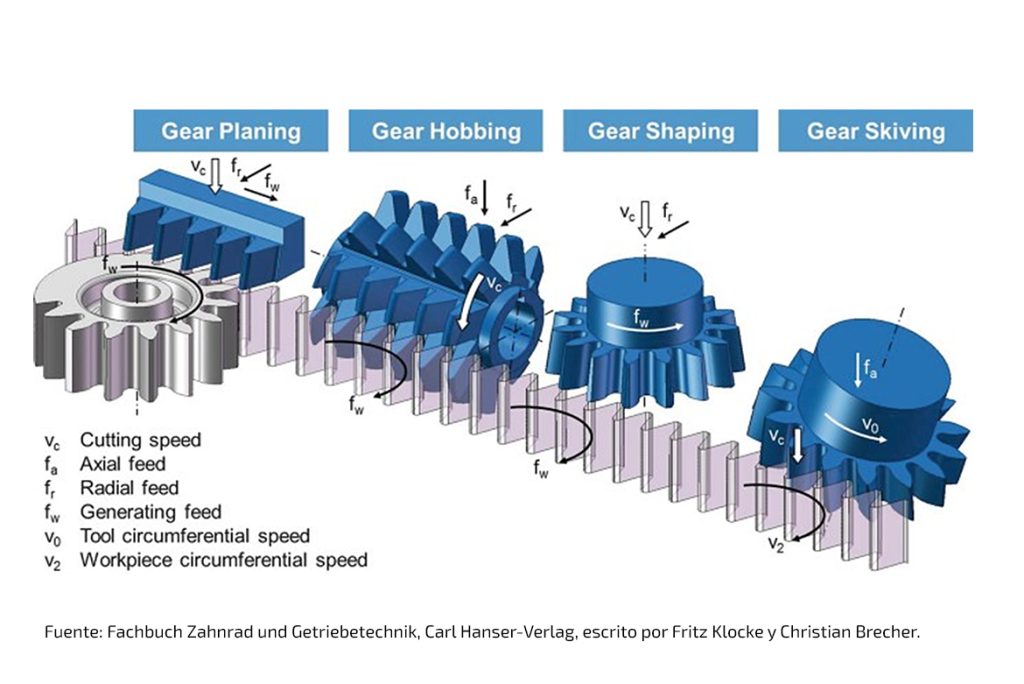
Main manufacturing methods#
This video shows the manufacturing process of toothed wheels.
Molding/casting/sintering: For very large production runs (thousands of units) or special materials (bronze, plastic). The profile is formed directly in the mold.
Advantage: very low unit cost for large runs, complex shapes possible (e.g. double helical).
Limitation: medium tolerances (DIN 9-12); requires subsequent machining if precision is needed.
Use: Toys, household appliances, starter gears in automotive applications.
Form milling: A cutter with the profile of the tooth space removes material tooth by tooth. Each module requires a specific cutter (or a set of cutters for different ranges of \(z\)).
Advantage: Economical for short runs or prototypes; flexibility.
Limitation: The profile is not exact (approximated by sectors), less precise than generation.
Use: Repairs, spare parts, manufacturing of large gears (cranes, mills).
Generating milling (hobbing): The most common tool is the hob, a screw-shaped tool with cutting teeth that, rotating in sync with the workpiece, “cuts” the teeth. For spur gears, the Fellows shaper cutter (reciprocating motion) is also used. For helical and worm gears, the hob is standard.
Advantage: High precision (DIN 5-7), one tool serves for all values of \(z\) of the same module, high productivity.
Limitation: Requires specialized machines (gear-cutting/hobbing machines).
Use: Industrial production of medium/high-precision gears.
Broaching: A broach (a long tool with progressive teeth) is pushed or pulled through the workpiece, cutting all the teeth in a single pass. Very fast (seconds per part).
Advantage: Very high productivity for large runs.
Limitation: Very expensive tool (thousands of euros), only for internal gears (internal ring gear), fixed geometry.
Use: Internal gears in automatic gearboxes, synchronizers.
Gear grinding: After cutting and heat treatment (hardening), the gear distorts slightly. Grinding with an abrasive wheel (Maag, Reishauer type) corrects the profile without heating the material (avoiding new stresses).
Advantage: Very tight tolerances (DIN 3-5), correction of hardening distortion, excellent surface finish.
Limitation: Slow, expensive process; only justified for high precision.
Use: Turbine gears, aerospace transmissions, precision machine tools.
Lapping and honing: Final finishing operations with fine abrasive pastes or honing tools. They remove micro-irregularities, improve surface roughness (Ra < 0.4 µm), and reduce noise and initial wear (running-in).
Use: High-speed gears, luxury transmissions, quiet applications (premium automobiles).
Quality control#
After manufacturing, the following are checked:
Pitch: with a pitch tester (pitch comb gauge).
Involute profile: with coordinate measuring machines (CMM) or profile projectors.
Roughness: contact/optical roughness testers.
Hardness: Rockwell/Vickers tests on the surface zone (important after hardening).
Noise: dynamic bench tests (single-flank test).