
Example 2.5: Kinematic analysis of a six-bar linkage#
Position analysis#
The figure shows a 6-bar linkage. At the instant when the crank forms an angle \(\theta_2 = 225^{\circ}\) with the horizontal, calculate the position of the slider, the angle that the segment \(O_4B\) forms with the horizontal, and the coordinates of point C.
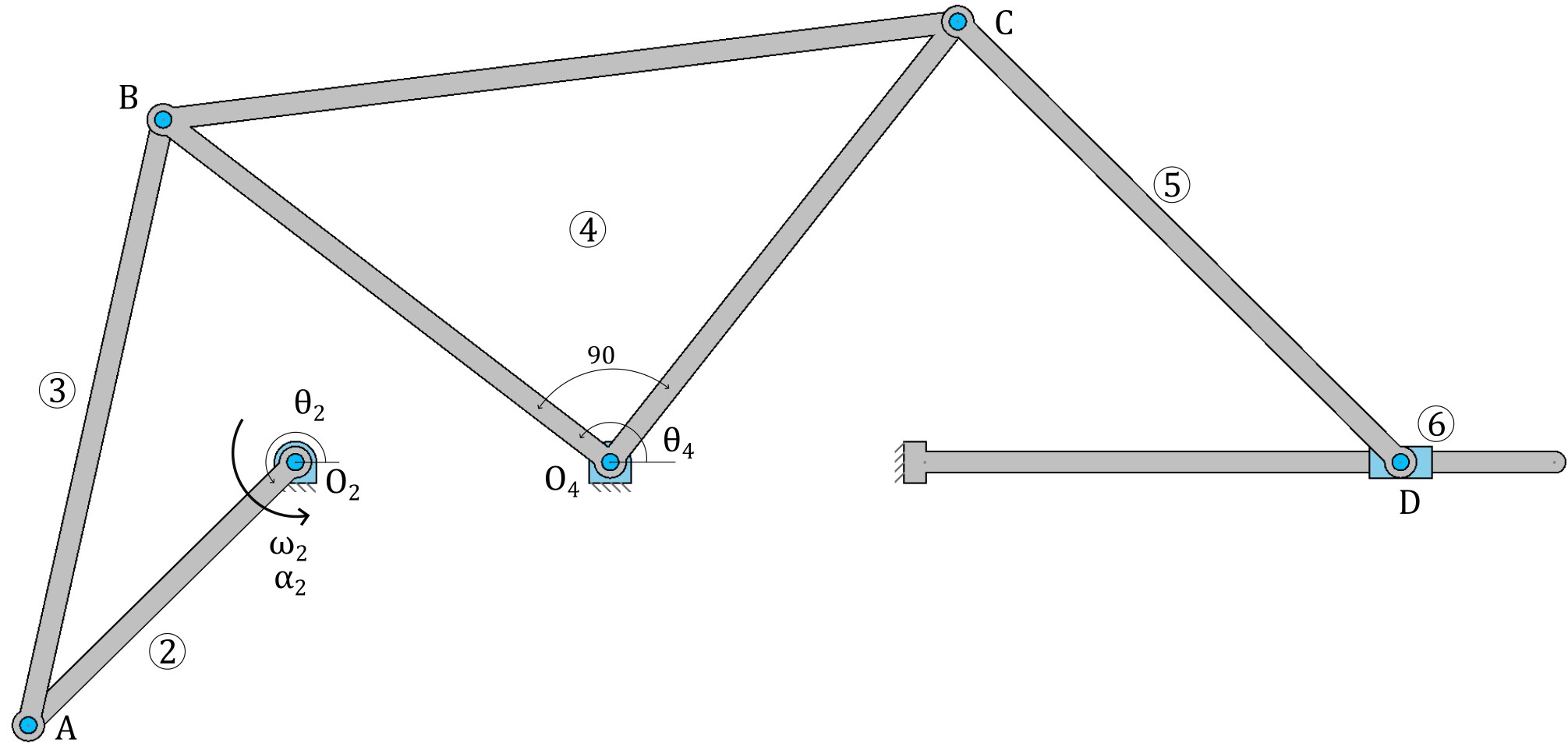
Data:
Link lengths, in meters: \(\overline{O_2 A} = 0.30;\, \overline{AB} = 0.5;\, \overline{O_4B} = \overline{O_4C} = 0.45;\, \overline{C D} = 0.50;\) the angle \(\gamma\) between \(\overline{O_4B}\) and \(\overline{O_4C}\) is \(90^\circ\). \(\overline{O_2 O_4} = 0.25;\) The slider moves horizontally on the x-axis.
Position analysis: graphical method#
The objective is to construct the mechanism to scale to measure the unknowns: the angle \(\theta_4\), the coordinates of point C, and the position of slider D.
Construction Procedure:#
Locate the fixed pivots: Place \(O_2\) at the origin (0,0) and \(O_4\) at (0.25, 0).
Position the crank (Link 2): From \(O_2\), draw link 2 with a length of 0.30 m and an angle \(\theta_2 = 225^\circ\) to find point A.
Close the first loop (4-bar):
Draw a circle with center A and radius \(\overline{AB} = 0.5\) m.
Draw a circle with center \(O_4\) and radius \(\overline{O_4B} = 0.45\) m.
The intersection of both circles gives the position of point B. Choose the solution that corresponds to the figure.
Locate point C:
Draw the line connecting \(O_4\) and B.
Rotate this line \(90^\circ\) clockwise around \(O_4\).
On this new line, measure a distance \(\overline{O_4C} = 0.45\) m from \(O_4\) to find point C.
Locate slider D:
Draw a circle with center C and radius \(\overline{CD} = 0.50\) m.
The intersection of this circle with the horizontal axis (x-axis) gives the position of slider D. Choose the solution that corresponds to the figure.
Measurement of results: Measure in the graphical software the angle of the bar \(O_4B\) (\(\theta_4\)), the coordinates of C, and the x-coordinate of D.
Position analysis: analytical method#
The problem is solved in two parts: first the four-bar loop \(O_2ABO_4\) and then the dyad \(O_4CD\).
Vector Loop Formulation (Loop 1: \(O_2ABO_4\))#
The loop equation is \(\vec{L}_2 + \vec{L}_3 = \vec{L}_1 + \vec{L}_4\). Decomposing into x and y components:
\(L_2\cos\theta_2 + L_3\cos\theta_3 = L_1 + L_4\cos\theta_4\)
\(L_2\sin\theta_2 + L_3\sin\theta_3 = L_4\sin\theta_4\)
Rearranging and squaring to eliminate \(\theta_3\), we arrive at an equation of the form \(A\cos\theta_4 + B\sin\theta_4 = C\), which allows solving for \(\theta_4\).
Numerical Calculation#
Initial Data:
\(L_1 = \overline{O_2O_4} = 0.25 \text{ m}\)
\(L_2 = \overline{O_2A} = 0.30 \text{ m}\)
\(L_3 = \overline{AB} = 0.5 \text{ m}\)
\(L_4 = \overline{O_4B} = 0.45 \text{ m}\)
\(\overline{O_4C} = 0.45 \text{ m}\)
\(\overline{CD} = 0.50 \text{ m}\)
\(\theta_2 = 225^\circ\)
\(\gamma = 90^\circ\) (angle \(\angle BO_4C\), clockwise)
1. Solve the 4-bar loop (\(O_2ABO_4\)): Freudenstein’s equation is solved for \(\theta_4\). The constants are:
\(A = 2L_1L_4 - 2L_2L_4\cos\theta_2 = 2(0.25)(0.45) - 2(0.3)(0.45)\cos(225^\circ) = 0.4159\)
\(B = -2L_2L_4\sin\theta_2 = -2(0.3)(0.45)\sin(225^\circ) = 0.1909\)
\(C = L_3^2 - L_1^2 - L_2^2 - L_4^2 + 2L_1L_2\cos\theta_2 = 0.5^2 - 0.25^2 - 0.3^2 - 0.45^2 + 2(0.25)(0.3)\cos(225^\circ) = -0.2111\)
Solving \(0.4159\cos\theta_4 + 0.1909\sin\theta_4 = -0.2111\) yields two solutions. The one corresponding to the figure is:
\(\mathbf{\theta_4 = 142.13^\circ}\)
2. Calculate the position of point C: The link \(\overline{O_4C}\) forms an angle \(\theta_C\) with the horizontal. Since the angle \(\gamma = \angle BO_4C\) is \(90^\circ\) clockwise (subtracting from the angle of bar 4): \( \theta_C = \theta_4 - \gamma = 142.13^\circ - 90^\circ = 52.13^\circ \) The coordinates of C are (relative to \(O_4\) which is at (0.25, 0)): \( x_C = x_{O_4} + \overline{O_4C}\cos\theta_C = 0.25 + 0.45\cos(52.13^\circ) = 0.25 + 0.276 = 0.526 \text{ m} \) \( y_C = y_{O_4} + \overline{O_4C}\sin\theta_C = 0 + 0.45\sin(52.13^\circ) = 0.355 \text{ m} \)
Coordinates of C: (0.526, 0.355) m
3. Calculate the position of slider D: Point D is on the x-axis (\(y_D=0\)). The distance \(\overline{CD}\) is \(0.50 \text{ m}\). Using the Pythagorean theorem in the triangle formed by C, D, and the projection of C on the x-axis: \( (\overline{CD})^2 = (x_C - x_D)^2 + (y_C - y_D)^2 \) \( 0.5^2 = (0.526 - x_D)^2 + (0.355 - 0)^2 \) \( 0.25 = (0.526 - x_D)^2 + 0.126 \) \( (0.526 - x_D)^2 = 0.124 \implies 0.526 - x_D = \pm\sqrt{0.124} = \pm 0.352 \) The two possible solutions for \(x_D\) are \(x_D = 0.526 \mp 0.352\). The one corresponding to the figure (further to the right) is:
Position of slider D: \(x_D = 0.878 \text{ m}\)
Final Position Results:
Angle of link 4: \(\mathbf{\theta_4 = 142.13^\circ}\)
Coordinates of C: (0.526, 0.355) m
Position of slider D: \(\mathbf{x_D = 0.878}\)