Gear Typology#
Geometric diversity according to shaft configuration#
Although the involute profile is common to almost all gears, the tooth geometry and the wheel geometry vary according to the relative orientation of the shafts to be connected and the load, speed, and noise requirements.
The basic classification follows the spatial relationship between the shafts:
1. Parallel shafts: spur and helical gears#
Spur gears: The teeth are parallel to the axis of rotation. They are the simplest to manufacture and generate no axial forces. High efficiency (98-99%). However, contact between teeth happens all at once (the whole line of contact engages simultaneously), which produces impacts and noise at high speeds. Typical use: household appliances, toys, low/medium-speed gearboxes, simple machine tools.
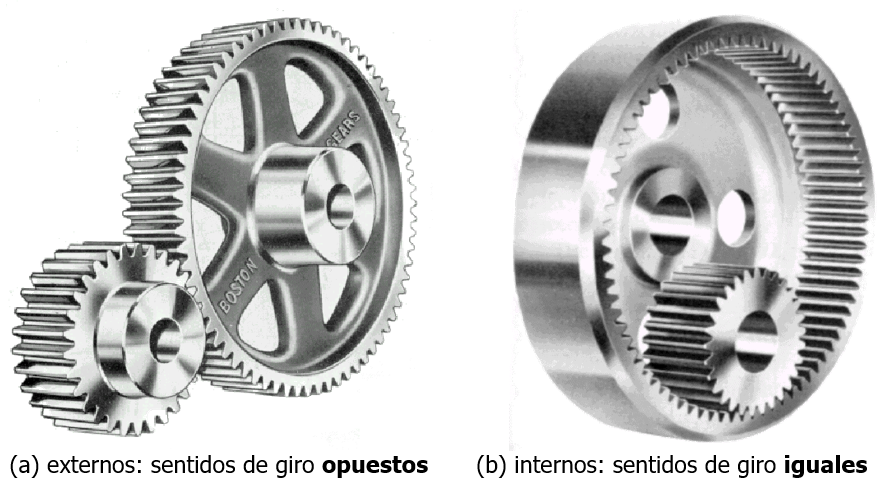
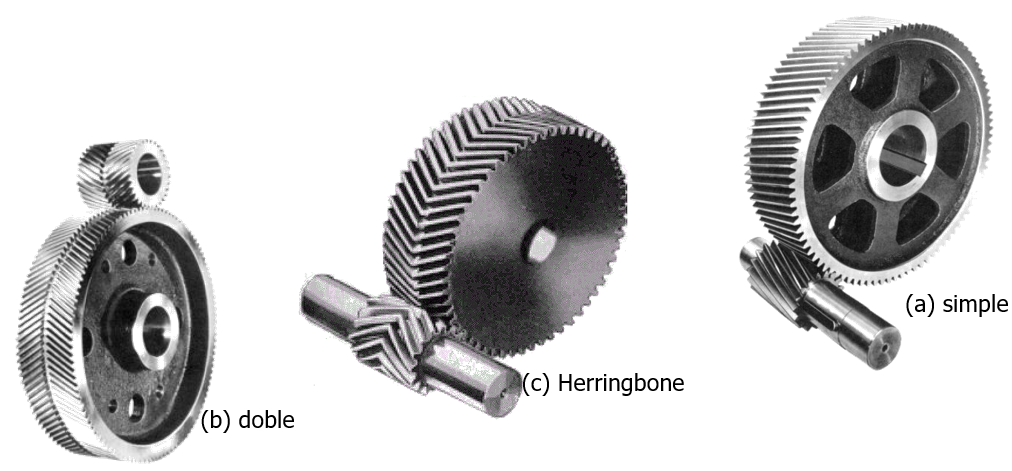
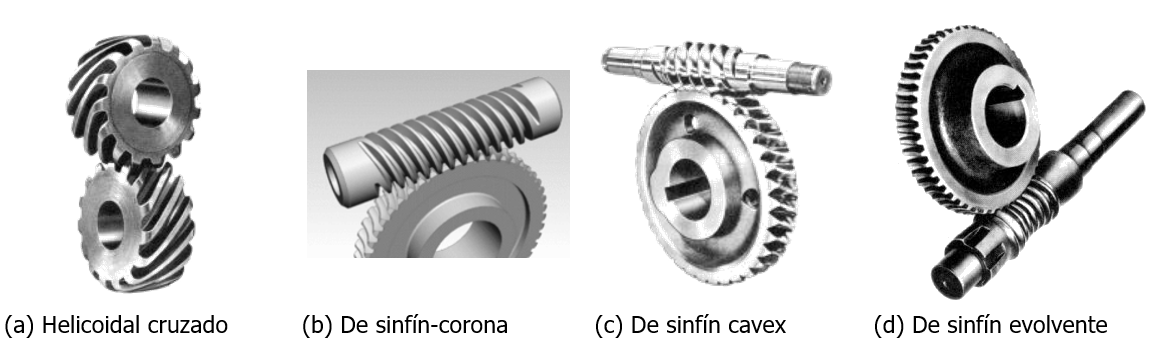
Helical gears: The teeth form a helix around the axis. Contact is progressive (it starts at one end of the tooth and gradually advances), which makes them much quieter and smoother. They have a higher contact ratio (\(\varepsilon_\alpha\) increases) and can transmit more power. Drawback: they generate an axial force component that must be absorbed by the bearings. Typical use: automotive gearboxes, high-speed industrial transmissions, compressors.
Double helical (herringbone): Two helices of opposite hand on the same wheel. They cancel out the axial thrust, keeping all the advantages of helical gears. They are very rugged and capable of transmitting large amounts of power. Drawback: complex and expensive to manufacture (requires special cutters or very precise generating machining). Typical use: large power gearboxes (turbines, rolling mills, ships), where the cost is justified.
2. Intersecting shafts: bevel gears#
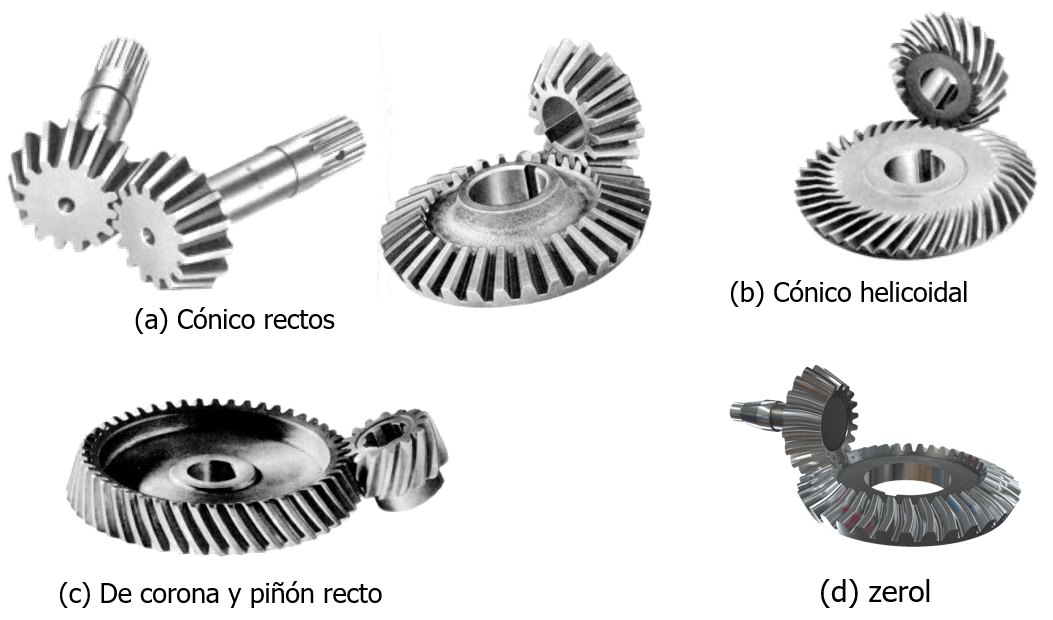
When the input and output shafts intersect (typically at 90°, but any angle is possible), bevel gears are used. Instead of cylinders, the pitch surfaces are cones.
Straight bevel gears: The teeth are straight and run from the apex of the cone to its base. They are the bevel version of spur gears. Pros: relatively simple, economical manufacturing. Cons: noisy at high speed, contact is abrupt. Typical use: 90° changes of direction in low/medium-speed applications (pillar drills, simple right-angle gearboxes).
Spiral bevel gears (Gleason system): The teeth are curved, similar to helical gears but on a conical surface. Contact is progressive, which makes them much smoother, quieter, and stronger. Cons: complex manufacturing (requires specialized Gleason or Klingelnberg machines), more expensive. Typical use: automotive differentials (front/rear axle), helicopter transmissions, high-speed, high-precision applications.
3. Crossed (skew) shafts, non-intersecting#
When the shafts are neither parallel nor intersecting (they cross in space), special geometries with significant relative sliding are used:
Hypoid gears: Similar to spiral bevel gears, but with the shafts offset vertically (they do not intersect). This geometry lets an automobile lower the driveshaft position (improving cabin space) and use sturdier pinions. They have a lot of relative sliding, which generates heat and requires extreme-pressure (EP) lubricants. Typical use: differentials in modern automobiles.
Worm and worm gear: The pinion is a worm (with one or more threads/starts) and the wheel is a helical gear (worm wheel) that wraps around it. It allows enormous reductions in a single stage (ratios from 20:1 to 100:1 or more). It is very quiet because contact is a “rubbing” type over a large surface.
Irreversibility: If the lead angle of the worm’s helix is small (\(\tan\gamma < \mu\), where \(\mu\) is the friction coefficient), the worm wheel cannot drive the worm. This is useful as a safety brake (hoists, lifting tables, adjustment screws).
Cons: Low efficiency (50-80%) due to high sliding. Generates a lot of heat; requires good cooling and lubrication.
Typical use: Elevators, conveyor belts, positioning mechanisms, compact high-reduction gearboxes, tuning pegs of musical instruments.
4. Motion transformation: rotation ↔ translation#
Rack and pinion: The rack is a gear of infinite radius (straight teeth on a bar). As the pinion rotates, it makes the rack move linearly (or vice versa). Relation: \(v = r \cdot \omega\) (linear velocity = pitch radius × angular velocity). It is the most direct and precise way to convert rotation into translation. Watch out for backlash: in precision applications (CNC) preloaded or double-rack systems are used. Typical use: automotive steering, machine-tool tables (lathes, CNC milling machines), automatic doors, elevators (vertical rack).