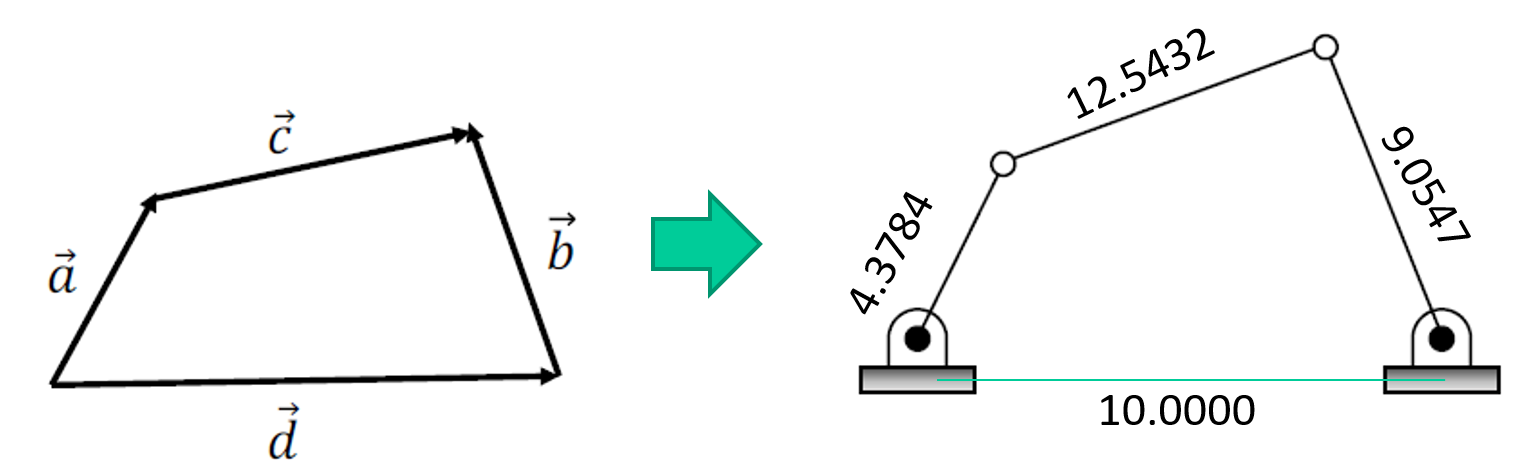
Example 6.1#
Design a four-bar crank-rocker mechanism in which the rocker is at the angular positions of 55, 60, and 100º when the crank is at 30, 50, and 130º respectively, knowing that the center distance is d=10 cm.
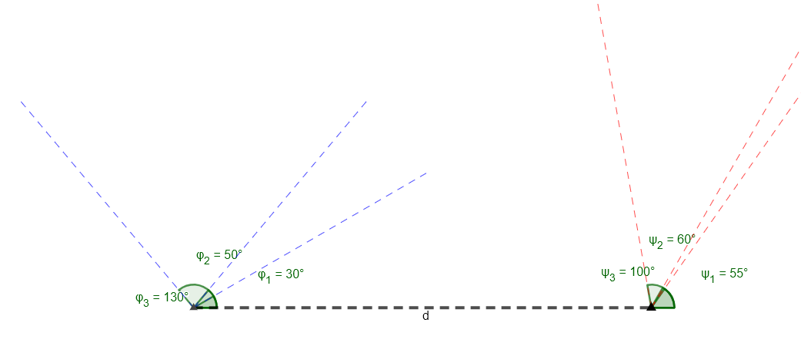
Since this involves 3 precision points, Freudenstein’s equation leads to the following system:
\[ K_1 \cos \psi_1 +K_2 \cos \phi_1 +K_3 =\cos (\phi_1 -\psi_1 ) \]
\[ K_1 \cos \psi_2 +K_2 \cos \phi_2 +K_3 =\cos (\phi_2 -\psi_2 ) \]
\[ K_1 \cos \psi_3 +K_2 \cos \phi_3 +K_3 =\cos (\phi_3 -\psi_3 ) \]
Where we know \(\phi_i\) and \(\psi_i\) for \(i=1,2,3\). Using the following MATLAB instructions:
clear,clc,close all
phi=deg2rad([30 50 130]);
psi=deg2rad([55 60 100]);
A=[cos(psi(1)) -cos(phi(1)) 1; ...
    cos(psi(2)) -cos(phi(2)) 1; ...
    cos(psi(3)) -cos(phi(3)) 1];
b=[cos(psi(1)-phi(1));...
    cos(psi(2)-phi(2));...
    cos(psi(3)-phi(3))];
We solve the system expressed as Ax=b, which gives us the constants \(K_1\), \(K_2\), and \(K_3\), from which we obtain the bar lengths:
Ki=A\b;
K1=Ki(1); K2=Ki(2); K3=Ki(3);
Given that:
d=10;
a=d/K1;
b=d/K2;
c=sqrt(-K3*2*a*b+d^2+b^2+a^2);
We obtain: a = 4.3784, b = 9.0547, c = 12.5432.