
Example 2.12: Thumb motion (3D relative motion)#
While the lecturer explains relative motion, a Machine and Mechanism Theory student is busy replying to a message on their phone (2013 exam). Consider the mechanical system formed by the palm of the hand holding the phone (taken as the reference frame, or “ground”) and the two bones (phalanges) of the thumb. Find:
Consider the motion of the thumb as it moves towards the touch screen (see figure), when there is only angular velocity and acceleration of \(OA\) with respect to ground and of \(AB\) with respect to \(OA\); that is, \(\omega_3=0\) in this case. Compute the velocity and acceleration of the fingertip (point \(B\)) with respect to the palm. Note: the given angular velocity \((\omega_2)_1\) is that of link \(AB\) relative to link \(OA\).
If a rotation of the thumb is now added, to reach a letter further to the left, with constant velocity \(\omega_3=2~rad/s\), what are the velocity and acceleration of the fingertip now?
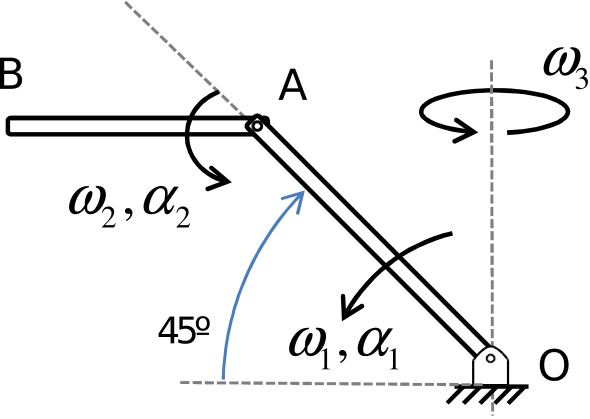

Data: \(|AB|=3~cm\), \(|OA|=4~cm\), \(\omega_1=5~rad/s\), \(\alpha_1=3~rad/s^2\), \((\omega_2)_1=10~rad/s\), \((\alpha_2)_1=4~rad/s^2\).
Solution
1. Thumb motion (with \(\omega_3=0\))
We use the following \(XYZ\) coordinate system (with \(Z\) pointing out of the page):
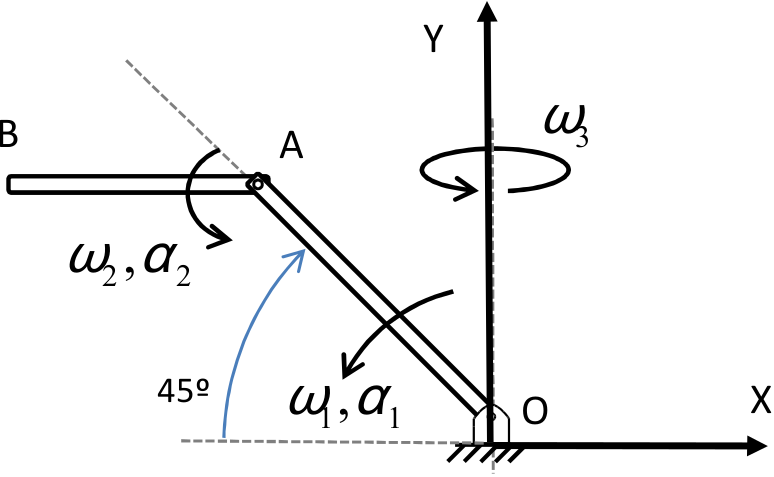
There are two rigid bodies: \(OA\) and \(AB\). It may be tempting to write the motion of point \(B\) directly with respect to point \(O\) as if it were a single body, but that would be wrong: there is not one rigid body from \(O\) to \(B\), but two.
We obtain the velocity of \(B\) from the fact that it belongs to rigid body \(AB\), starting from the velocity of point \(A\):
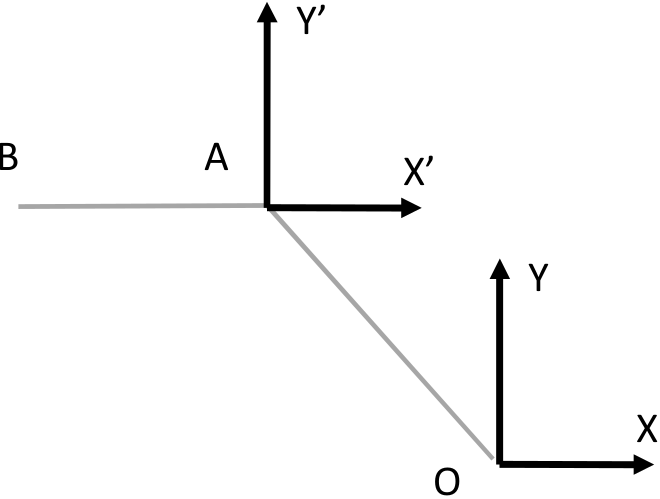
where all vectors are expressed in the global \(XYZ\) system. The velocity of \(A\) follows from noting that this point also belongs to rigid body \(OA\), which rotates about \(O\) (a fixed point) with angular velocity \(\vec{\omega}_{OA} = \vec{\omega}_1 = 5\,\hat{k}\):
The angular velocity of link \(AB\) is the vector sum of that of \(OA\) (\(\vec{\omega}_1\)) and that of \(AB\) relative to \(OA\) (\(\vec{\omega}_2\)):
Substituting, with \(\vec{r}_{AB} = -3\,\hat{i}\):
For the acceleration of \(B\) we write the corresponding equation, again with rigid body \(AB\), known point \(A\) and target point \(B\):
for which we first need the acceleration of point \(A\):
and, since both rotation axes are parallel to \(\hat{k}\):
we can substitute everything to obtain the acceleration of \(B\):
2. Including the rotation \(\omega_3\)
Solution method 1
Now the system formed by links \(OA\) and \(AB\) also rotates about the \(Y\) axis with \(\vec{\omega}_3 = 2\,\hat{j}\), so the \(XYZ\) system used before is no longer fixed. We need a new fixed reference frame (\(X''Y''Z''\)), with respect to which the whole system of the previous part rotates:
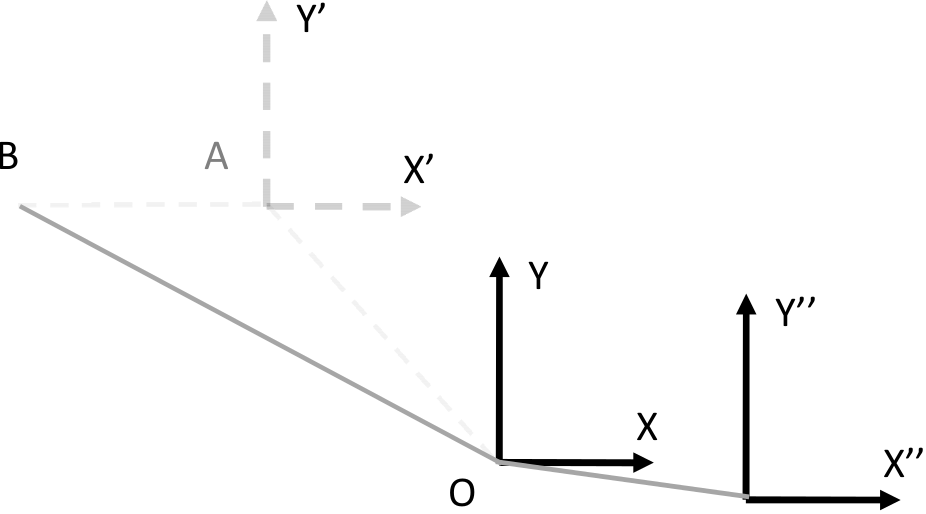
where \(XYZ\) has been drawn apart from \(X''Y''Z''\) for clarity, although both share the origin \(O\) and only differ by the rotation due to \(\vec{\omega}_3\) (with \(\dot{\vec{\omega}}_3 = 0\)).
From this viewpoint, the motion of \(B\) is that of a moving point in a moving reference frame (we cannot assume that \(B\) moves as a point rigidly attached to \(XYZ\)). Knowing the velocity and acceleration of \(B\) with respect to \(XYZ\) (those from the previous part), we apply the relative-motion equations (with \(\vec{v}_O = \vec{a}_O = 0\) and \(\vec{r}_{OB} = \left(-3 - \tfrac{4}{\sqrt{2}}\right)\hat{i} + \tfrac{4}{\sqrt{2}}\,\hat{j}\)):
Solution method 2
Alternatively, we can reuse the equations from the first part, adding the new component \(\vec{\omega}_3\) to the absolute angular velocities of both links:
Care is needed with the angular accelerations: vectors \(\vec{\omega}_1\) and \(\vec{\omega}_2\) point along \(\hat{k}\), which now rotates with \(\vec{\omega}_3\), so their time derivative has an extra term:
Substituting these values into the equations for \(\vec{v}_A\), \(\vec{v}_B\), \(\vec{a}_A\) and \(\vec{a}_B\) from the first part gives the same result as method 1. If the \(\vec{\omega}_3 \times \vec{\omega}\) term were left out, the \(\hat{k}\) component of the acceleration would come out wrong (\(28.28\) instead of \(56.57~cm/s^2\)).