
Example 2.7: Bar with two sliders#
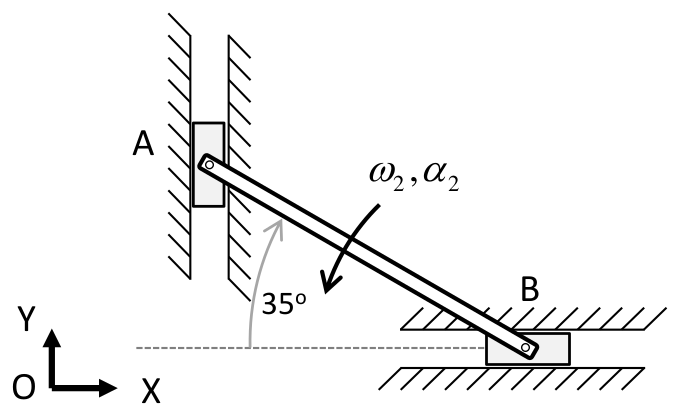
In the mechanism of the figure, slider \(A\) has an instantaneous velocity and acceleration of \(10~m/s\) and \(5~m/s^2\) respectively, both pointing downwards. If the distance \(AB\) is \(15~m\), find:
The linear velocity of \(B\) and the angular velocity of bar \(AB\).
The linear acceleration of \(B\) and the angular acceleration of bar \(AB\).
Solution
Here we only need to study one rigid body, bar \(AB\) (Body 2), since it already contains both points of interest, \(A\) and \(B\). As there are no sliders moving along rotating bodies, we only need the rigid-body equations (there is no Coriolis acceleration).
From the statement, \(\vec{v}_A=-10\,\hat{j}\) and \(\vec{a}_A=-5\,\hat{j}\), and from the mechanism constraints, \(\vec{v}_B = v_B\,\hat{i}\) and \(\vec{a}_B = a_B\,\hat{i}\). Since the mechanism is planar, \(\vec{\omega}_2 = \omega_2\,\hat{k}\) and \(\vec{\alpha}_2 = \alpha_2\,\hat{k}\). The angle from \(A\) towards \(B\) is \(35^\circ\) clockwise (negative), so:
1. Velocities
We write the velocity equation for points \(A\) and \(B\) of rigid body 2:
Expanding the cross products (\(\hat{k}\times\hat{i}=\hat{j}\), \(\hat{k}\times\hat{j}=-\hat{i}\)):
Equating components gives a system of two scalar equations with two unknowns:
2. Accelerations
With all velocities known, we write the rigid-body acceleration equation. Since \(\vec{\omega}_2 \perp \vec{r}_{AB}\), the normal term simplifies to \(\vec{\omega}_2 \times (\vec{\omega}_2 \times \vec{r}_{AB}) = -\omega_2^2\,\vec{r}_{AB}\):
Equating components and solving for the two acceleration unknowns: