
Example 2.13: Carousel horse (3D relative motion)#
The following mechanism is a fairground carousel horse (February 2010 exam), whose rocking motion is driven by link \(AB\) rotating clockwise at angular velocity \(\omega_0\) (\(\vec{\omega}_0 = -\omega_0\,\hat{i}\), with the \(x\) axis pointing out of the page), while point \(C\) slides along a vertical slot.
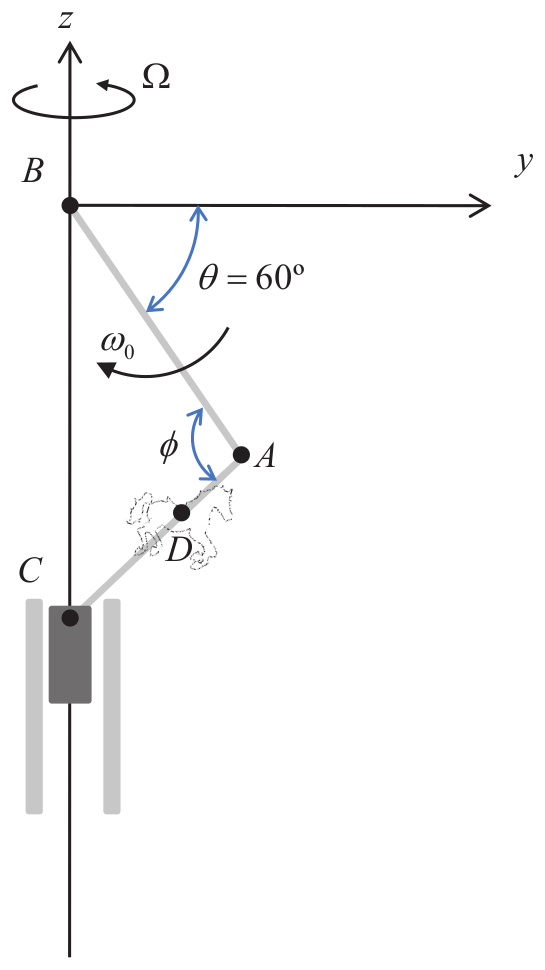
Knowing that at the initial instant the angle at \(A\) is a right angle (\(\phi=\frac{\pi}{2}\)), that \(\theta=\frac{\pi}{3}\), and that point \(D\) lies on bar \(AC\) (of length \(|AC|=R\)) at a distance \(\frac{1}{3}R\) from \(A\), compute:
The angular velocity \(\omega_{AC}\) of bar \(AC\).
The velocity of the horse (point \(D\)).
The acceleration of the same point, knowing that \(\vec{a}_A = \omega_0^2 \frac{R}{8} (-\sqrt{3}\,\hat{j} + \hat{k})\) and that the motion of bar \(AC\) can be considered uniform.
In addition to the rocking motion of the horse, now consider the uniform counterclockwise rotation \(\Omega\) of the carousel platform about a vertical axis through its center. Assuming the horse is 2 meters away from the rotation axis (with the axis to its left), compute:
The absolute velocity of the horse.
The absolute acceleration of the horse.
Solution
1. Angular velocity \(\omega_{AC}\) of bar \(AC\)
Because of the constraint at point \(C\), for each position of bar \(AB\), bar \(AC\) is forced into a single compatible position. Therefore, an angular velocity \(\omega_0\) of \(AB\) induces an angular velocity of \(AC\) in the opposite sense:
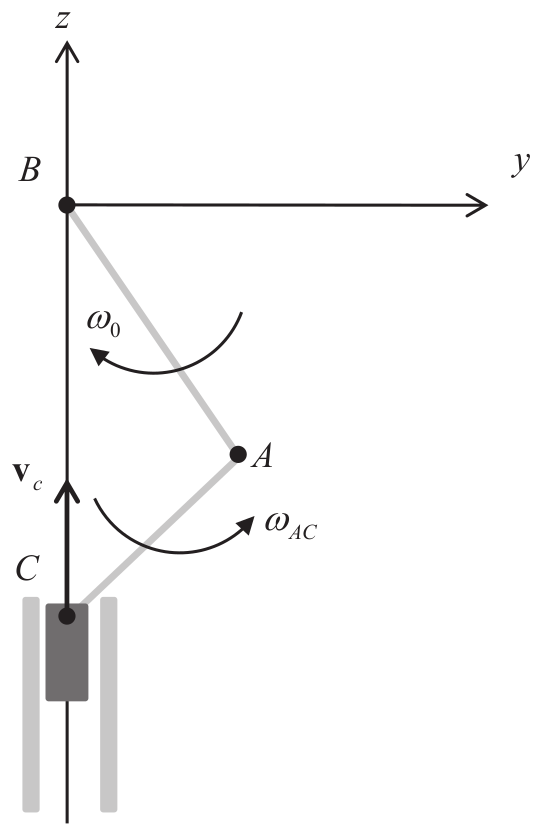
To find \(\omega_{AC}\) we relate it to the velocity of point \(C\), \(\vec{v}_C\), and impose that its horizontal component must be zero (because of the slot). Point \(C\) belongs to a body (bar \(AC\)) rotating with angular velocity \(\omega_{AC}\), for which we know the velocity of another point (\(A\)), so:
The velocity of \(A\) is the time derivative of its position vector \(\vec{r}_{BA}\) (of magnitude \(\sqrt{3}R\)), a constant-magnitude vector rotating with angular velocity \(\vec{\omega}_0\):
In addition, from the geometry of the problem:
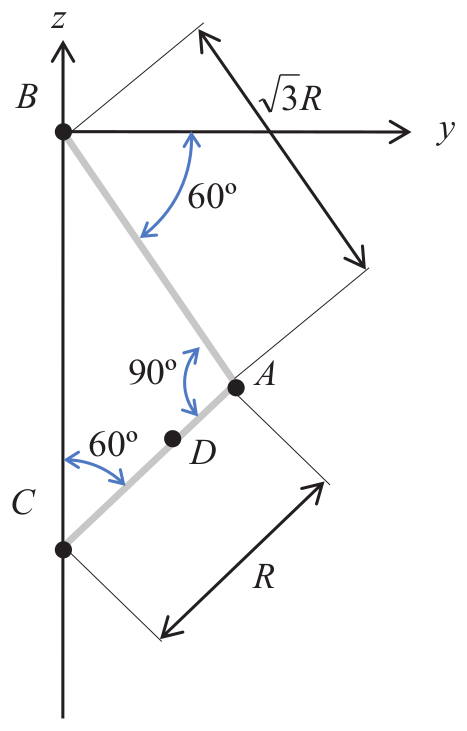
we know that, at the instant of interest:
Since \(\vec{\omega}_{AC} = \omega_{AC}\,\hat{i}\), substituting:
We now apply the constraint on point \(C\), which can only move vertically: \(\vec{v}_C = v_C\,\hat{k}\). Equating component by component gives a system of two equations with two unknowns (\(v_C\) and \(\omega_{AC}\)):
The velocity of \(C\) comes out negative because it was taken as positive along the \(Z\) axis: for \(\omega_0 > 0\), point \(C\) moves down at the instant of interest.
2. Velocity of point \(D\)
This is the same situation as before: knowing the velocity of one point (\(A\)) of a rigid body (bar \(AC\)) rotating with angular velocity \(\vec{\omega}_{AC}\), find the velocity of another point of the same body (\(D\)), with \(\vec{r}_{AD} = \frac{1}{3}\vec{r}_{AC}\):
3. Acceleration of point \(D\)
Differentiating the previous velocity equation, and noting that the motion of \(AC\) is uniform (\(\dot{\vec{\omega}}_{AC} = 0\)) and that \(\vec{\omega}_{AC} \perp \vec{r}_{AD}\):
4. Absolute velocity of \(D\), including the rotation \(\Omega\)
\(\vec{v}_D\) is now a velocity relative to the carousel platform, which rotates with \(\vec{\Omega} = \Omega\,\hat{k}\). With \(\vec{r} = 2\,\hat{j}\) the vector from the rotation axis to \(D\) (in meters), the transport term is \(\vec{\Omega} \times \vec{r}\), and the origin of the moving frame (on the rotation axis) is fixed:
Only the distance to the rotation axis matters, not the exact position of the reference point chosen on that axis: the vertical component of the relative position vector is parallel to \(\vec{\Omega}\) and does not contribute to the cross product.
5. Absolute acceleration of \(D\)
We just substitute, into the acceleration formula for a moving point in a moving reference frame, the velocity and acceleration of \(D\) relative to the carousel obtained in parts 2 and 3 (with \(\dot{\vec{\Omega}} = 0\)):