
Example 2.8: Two bars with two sliders#
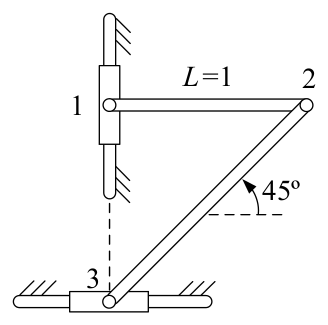
For the mechanism in the figure (problem adapted from [AI14]), find the instantaneous velocity and acceleration of point 2.
Data: \(L=1~m\); velocities \(\vec{v}_1 = 1\,\hat{j}~(m/s)\), \(\vec{v}_3 = 1\,\hat{i}~(m/s)\); accelerations \(\vec{a}_1 = 1\,\hat{j}~(m/s^2)\), \(\vec{a}_3 = 1\,\hat{i}~(m/s^2)\).
Solution
We must find equations of motion that relate the known variables (the state of points 1 and 3) to the unknown ones (those of point 2). From the figure, point 2 lies a distance \(L=1\) to the right of point 1 and, since bar 32 makes a \(45^\circ\) angle, also a height \(1\) above point 3:
There are two clear relations:
Rigid body 12: point 2 belongs to bar 12, so we take point 1 as the reference: \(\vec{v}_2 = \vec{v}_1 + \vec{\omega}_{12} \times \vec{r}_{12}\).
Rigid body 32: likewise, point 2 belongs to bar 32: \(\vec{v}_2 = \vec{v}_3 + \vec{\omega}_{32} \times \vec{r}_{32}\).
The order of the terms matters, although the roles of the two points can be swapped as long as the vector joining them is also reversed. For example, the first equation would also be correct as \(\vec{v}_1 = \vec{v}_2 + \vec{\omega}_{12} \times \vec{r}_{21}\).
Velocities
Together, both equations form a system of 4 scalar equations (each planar vector equation counts as two) with four unknowns: \(v_{2x}\), \(v_{2y}\), \(\omega_{12}\) and \(\omega_{32}\). Expanding the cross products:
Equating the \(\hat{i}\) components: \(0 = 1 - \omega_{32}\), so \(\omega_{32} = 1~rad/s\). Equating the \(\hat{j}\) components: \(1 + \omega_{12} = \omega_{32} = 1\), so \(\omega_{12} = 0\). Therefore:
Accelerations
In the same way, we write the acceleration equations of point 2 as a point of rigid bodies 12 and 32 (with \(\vec{\omega} \times (\vec{\omega} \times \vec{r}) = -\omega^2\,\vec{r}\) in the plane):
Again, four equations with four unknowns (\(a_{2x}\), \(a_{2y}\), \(\alpha_{12}\) and \(\alpha_{32}\)). Equating components: \(0 = -\alpha_{32}\) and \(1 + \alpha_{12} = \alpha_{32} - 1\), which gives: