
Example 2.11: Rocker with a pin in a rotating slot#
Pin \(A\) of rocker \(AO_3\) is constrained to move inside the rotating slot of arm \(O_2D\) (February 2016 exam). The arm’s angular velocity is \(\omega_2 = 2~rad/s\) clockwise, and it remains constant at the instant of interest. For the position shown in the figure (with \(AO_3\) horizontal), find:
Using the analytical method, the absolute velocity of pin \(A\) and its velocity relative to the rotating slot of \(O_2D\).
The angular acceleration of \(AO_3\) and the acceleration of \(A\) relative to the slot of the rotating arm \(O_2D\).
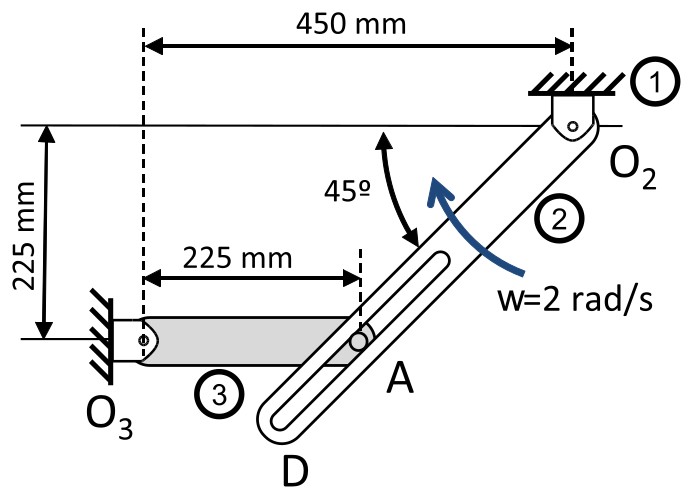
Solution
From the figure, with \(\hat{i}\) pointing right and \(\hat{j}\) pointing up (in mm):
1. Absolute velocity of \(A\) and velocity relative to \(O_2D\)
For point \(A_3\), which belongs to Body 3, we write the rigid-body equation:
On the other hand, the same point \(A_3\) can be seen as a point moving relative to Body 2, with relative velocity \((\vec{v}_{A_3})_2\):
where \(\vec{v}_{O_2}=0\), and the relative velocity has been split into an unknown magnitude, \((v_{A_3})_2\), and a known direction: that of the slot at the instant studied. The unit vector at \(45^\circ\) (pointing from \(A\) towards \(O_2\)) has been chosen arbitrarily, so the sign of \((v_{A_3})_2\) will give the actual sense.
Equating both expressions:
The \(\hat{i}\) component gives \((v_{A_3})_2\), and the \(\hat{j}\) component gives \(\omega_3\):
The positive relative velocity means that pin \(A\) moves towards \(O_2\) along the slot, while rocker 3 rotates counterclockwise. The absolute velocity of \(A\) is:
2. Angular acceleration of \(AO_3\) and acceleration of \(A\) relative to the slot
We write the acceleration equations corresponding to the two velocity expressions above. The second one includes the Coriolis term, since \(A\) moves relative to a rotating body (Body 2):
Dropping the zero terms (\(\vec{a}_{O_3}=\vec{a}_{O_2}=0\), and \(\vec{\alpha}_2=0\) since \(\omega_2\) is constant) and using \(\vec{\omega} \times (\vec{\omega} \times \vec{r}) = -\omega^2\,\vec{r}\) when \(\vec{\omega} \perp \vec{r}\), we equate both:
which is a system of two equations with two unknowns: \(\alpha_3\) and the magnitude \((a_{A_3})_2\) of the relative acceleration, whose direction is again that of the slot. Evaluating each term:
Equating components:
The negative sign of \((a_{A_3})_2\) means the relative acceleration points from \(O_2\) towards \(D\), i.e., opposite to the relative velocity: the pin is slowing down in its motion towards \(O_2\) along the slot. As a check, both paths give the same absolute acceleration of \(A\): \(\vec{a}_{A_3} = -3600\,\hat{i} - 7200\,\hat{j}~(mm/s^2)\).