
Example 2.10: Disc with a sliding collar#
For the mechanism in the figure (February 2014 exam), knowing that the disc rotates at a constant 90 rpm clockwise, use the analytical method to find the velocity of the end of the bar (point 2).
Data: all dimensions are in millimeters.
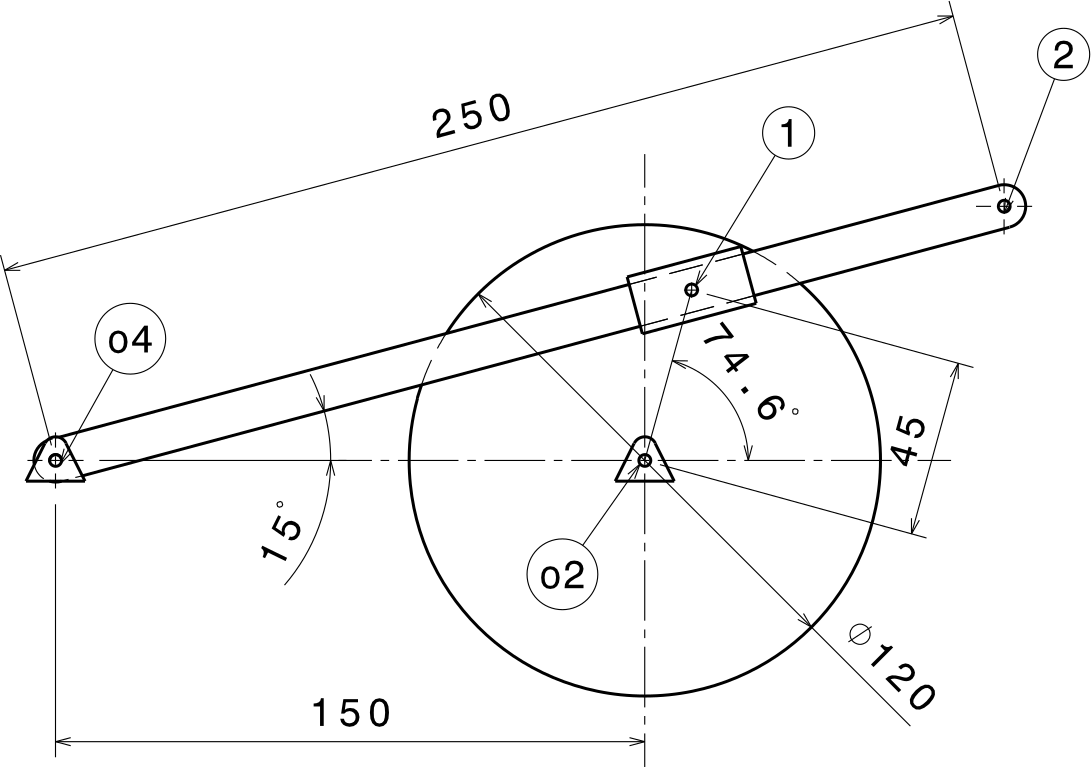
Solution
We use an \(XY\) coordinate system with its origin at the center of the disc (\(O_2\)).
Since the angular velocity of the disc is known, we can compute the linear velocity of any of its points. We therefore need a connection point between the disc and bar \(O_4 2\) to find the bar’s angular velocity about \(O_4\), which will obviously differ from that of the disc.
The connection is point \(1\), where we distinguish three different physical points: \(1_D\) (point 1 on the disc), \(1_B\) (point 1 on the bar) and \(1_C\) (point 1 on the collar). Looking at how the collar slides along the bar while pivoting on the disc, it is clear that \(1_D\) and \(1_C\) always coincide (same coordinates, velocities and accelerations), while \(1_B\) can only move relative to them along the direction of the bar.
With this in mind, we can compute the velocity of point \(1_B\) in two ways:
As a point of rigid body \(O_4 2\):
As a point with a velocity relative to the disc of unknown magnitude and known direction (that of the bar, at \(15^\circ\)):
From the figure, \(\vec{r}_{O_2 1} = 45 \left(\cos 74.6^\circ\,\hat{i} + \sin 74.6^\circ\,\hat{j}\right) = 11.95\,\hat{i} + 43.38\,\hat{j}\) and \(\vec{r}_{O_4 1} = \vec{r}_{O_4 O_2} + \vec{r}_{O_2 1} = 161.95\,\hat{i} + 43.38\,\hat{j}\) (mm). The angular velocity of the disc is \(\vec{\omega}_{disc} = -90 \cdot \frac{2\pi}{60}\,\hat{k} = -9.42\,\hat{k}~(rad/s)\).
Equating both expressions, since they describe the same physical point, gives one planar vector equation, equivalent to two scalar equations with two unknowns (\(\omega_4\) and \(v_{rel}\)):
Solving:
The velocity of point \(2\) then follows from the equation of a point belonging to a rigid body: