
Example 3.10: Sliding door (rolling and sliding)#
A sliding door of mass \(m\) hangs from two rollers \(A\) and \(B\), of radius \(r_c\), which roll on a horizontal rail. The rolling resistance coefficient of the rollers is \(\rho\) and the dry friction coefficient between the rollers and the rail is \(\mu\). The center of mass \(G\) of the door is centered between the rollers, and the handle \(P\) is a distance \(h\) below the rail, at the same height as \(G\). Compute the horizontal force \(F\) to be applied at the handle to open the door (to the right) if:
Both rollers work properly and roll.
One of the rollers is jammed and slides instead of rolling.
Data: \(m = 125\) kg, \(l = 1\) m, \(h = 2.25\) m, \(r_c = 50\) mm, \(\mu = 0.2\), \(\rho = 5\) mm, \(g = 9.81\) m/s².
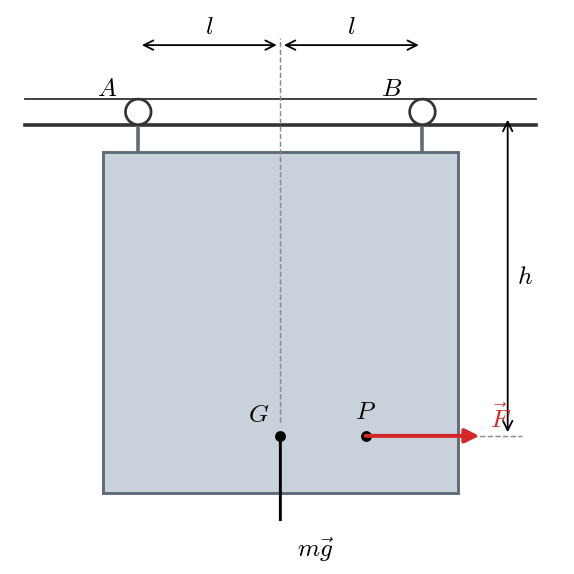
(Adapted from problem 7-17 of [CFCC01].)
Solution
The door is assumed to move slowly (no inertia effects) and friction at the roller axles is neglected.
Resisting force of each roller. The rail exerts on each roller a normal force \(N\) and a tangential force \(T\), opposite to the motion.
If the roller rolls, its axle exerts no torque on it, so the moment of \(T\) about the axle balances the rolling resistance moment: \(T\, r_c = \rho N\), that is, \(T = \dfrac{\rho}{r_c} N = 0.1\, N\).
If the roller is jammed, it slides on the rail and the friction force is \(T = \mu N = 0.2\, N\).
In both cases, \(T\) acts at the height of the rail and is transmitted to the door through the roller axle.
Equilibrium of the door. With \(\hat{i}\) to the right, the equations are:
Force \(F\) is at the height of \(G\) and has no moment about it. The tangential forces, a height \(h\) above, tend to tip the door, loading roller \(A\) (the rear one) and unloading \(B\):
1. Both rollers roll. \(T_A + T_B = \frac{\rho}{r_c}(N_A + N_B) = \frac{\rho}{r_c}\, mg\), which does not depend on how the load is shared:
2a. Roller \(A\) jammed. \(T_A = \mu N_A\) and \(T_B = \frac{\rho}{r_c} N_B\):
2b. Roller \(B\) jammed. \(T_A = \frac{\rho}{r_c} N_A\) and \(T_B = \mu N_B\):
It is worse if roller \(A\) jams: when the door is pulled, the load transfer loads it, so it carries the larger normal force.
(With \(g = 10\) m/s², as in the source, one gets \(125\), \(211\) and \(169\) N.)
Checking that the rollers roll in case 1. A roller rolls without slipping if the required tangential force fits within the friction cone: \(T = \frac{\rho}{r_c}N \le \mu N\), that is, \(\frac{\rho}{r_c} = 0.1 \le \mu = 0.2\). ✓