
Example 3.6: Inertia forces in a four-bar linkage (graphical method)#
The four-bar linkage of Example 3.5: Graphical static analysis of a four-bar linkage now moves with no external load, with the crank rotating at a constant \(\omega_2 = 15\) rad/s counterclockwise. The crank and the coupler have negligible mass, and the rocker is a uniform bar of mass \(m_4 = 3\) kg, with its center of mass \(G_4\) at the midpoint of \(O_4B\). At position \(\theta_2 = 45^\circ\), compute graphically:
The inertia loads of the rocker and its equivalent inertia force.
The joint reactions and the required input torque \(M_2\).
The total input torque if the force \(\vec{P}\) of example 3.5 also acts.
Data: \(\overline{O_2A} = 0.20\) m, \(\overline{AB} = 0.50\) m, \(\overline{O_4B} = 0.35\) m, \(\overline{O_2O_4} = 0.45\) m. Neglect weight and friction.
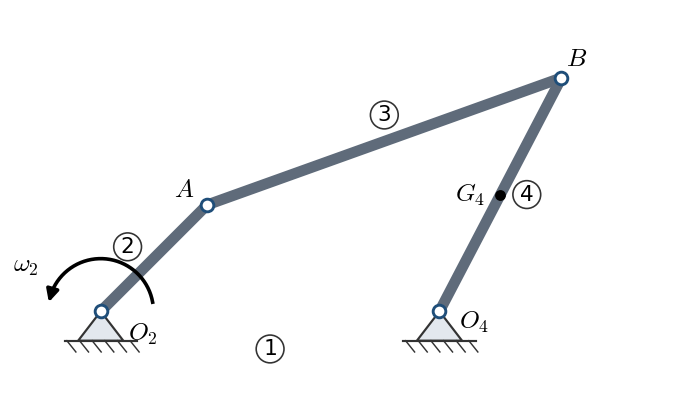
1. Kinematics and inertia loads
Kinematics. From the velocity and acceleration analysis (lesson 2, with polygons or analytically) at this position:
(positive means counterclockwise). The acceleration of the center of mass of the rocker, with \(\vec{r}_{O_4G_4} = \frac{1}{2}\vec{r}_{O_4B} = (0.0811, 0.1551)\) m, is:
Inertia loads. The moment of inertia of the bar about its center is \(I_{G_4} = \frac{1}{12} m_4 L_4^2 = \frac{1}{12} \cdot 3 \cdot 0.35^2 = 0.03063\) kg·m². Then:
Equivalent inertia force. We replace \(\vec{J}_4\) and \(M_{G_4}\) by a single force \(\vec{J}'_4 = \vec{J}_4\), shifted parallel to itself a distance:
towards the side where its moment about \(G_4\) is clockwise, like \(M_{G_4}\). Since \(\vec{J}_4\) points to the right and slightly downwards, it must be shifted upwards: its line of action goes through point \(K = (0.5477, 0.2100)\) m.
2. Reactions and input torque
The problem is now the same as in example 3.5, with \(\vec{J}'_4\) in place of \(\vec{P}\):
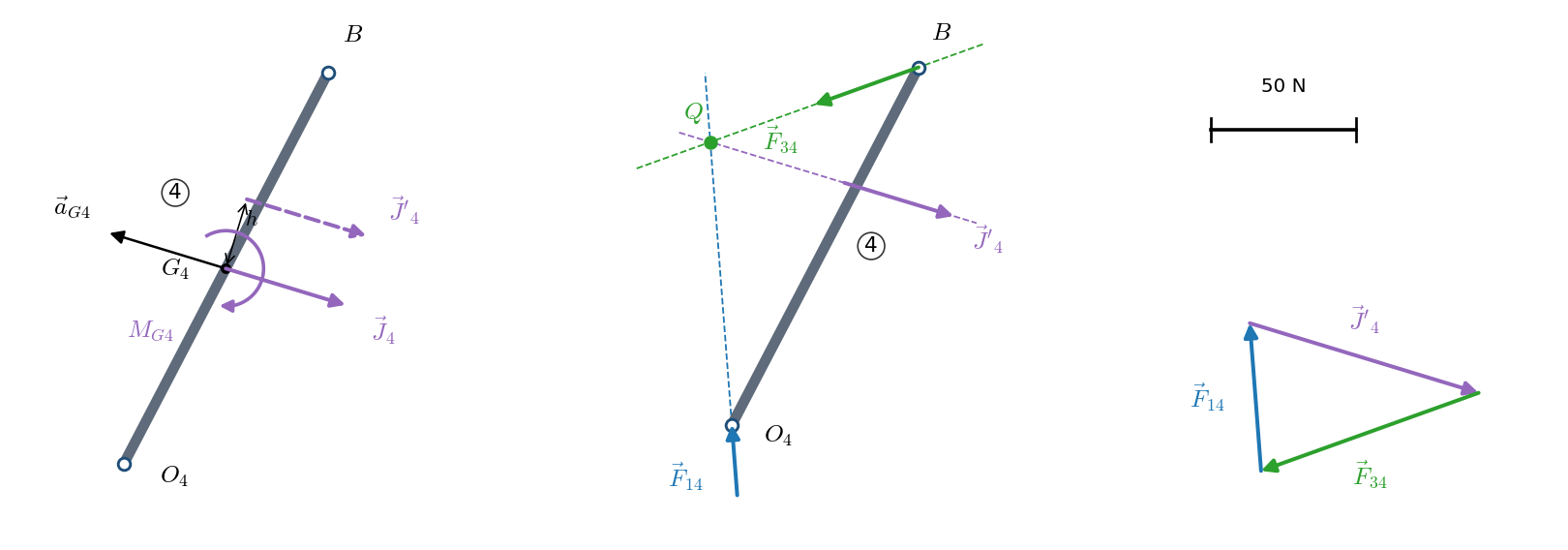
Coupler. No mass and no loads: two-force member, \(\vec{F}_{34}\) along \(AB\).
Rocker. Three forces: \(\vec{J}'_4\) (known), \(\vec{F}_{34}\) (along \(AB\)) and \(\vec{F}_{14}\) (through \(O_4\)). The line of \(\vec{J}'_4\) and line \(AB\) meet at \(Q = (0.4313, 0.2454)\) m, and \(\vec{F}_{14}\) acts along \(O_4Q\). The force triangle gives:
Now \(\vec{F}_{34}\) points from \(B\) towards \(A\): the coupler pulls the rocker (tension).
Crank. \(\vec{F}_{32} = -\vec{F}_{34} = 79.86~\text{N}\angle 19.7^\circ\) at \(A\), with the same arm \(d_2 = 0.0854\) m as before about \(O_2\). Its moment is clockwise, so the input torque is counterclockwise:
The motor must supply this torque to accelerate the rocker at this position.
Power check. \(M_2\,\omega_2 + \vec{J}_4\cdot\vec{v}_{G_4} + M_{G_4}\,\omega_4 = 0\), with \(\vec{v}_{G_4} = \vec{\omega}_4 \times \vec{r}_{O_4G_4} = (-0.837, 0.438)\) m/s:
3. Superposition with the external load
If the force \(\vec{P}\) of example 3.5 also acts, the problem is still linear (there is no friction), and by the superposition principle the reactions and the input torque are the sum of those of both cases:
At this position, \(\vec{P}\) acts in favor of the motion (on its own, it would force the motor to brake with \(7.97\) N·m), but the rocker is accelerating (\(\omega_4\) and \(\alpha_4\) have the same sign) and absorbs almost all that power: the motor only has to brake with \(1.15\) N·m. The reactions at \(O_4\) are added vectorially in the same way: \(\vec{F}_{14} = (12.10, -31.52) + (-3.89, 51.01) = (8.21, 19.49)\) N.
This is the complete kinetostatic analysis: static (loads) + dynamic (inertia).
Interactive construction#
Go through the construction step by step and drag the crank to see how the inertia force, its offset \(h\), the reactions and the input torque change over a revolution: