
Review of vector algebra#
Kinematics is written in the language of vectors. This page reviews the operations used throughout the lesson, with special attention to the cross product, which appears in every velocity and acceleration formula.
Coordinate systems#
A coordinate system consists of a point, called the origin, and a set of mutually perpendicular directions used to measure the position of any point or vector relative to that origin. Three-dimensional systems are the most general, but many problems can be simplified by using two-dimensional coordinates, as long as all displacements happen in a single plane.
A coordinate system is named after its axes (\(XYZ\)) or after the point at its origin (\(O\)).
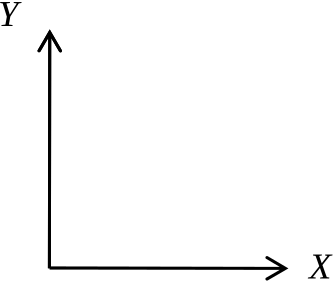
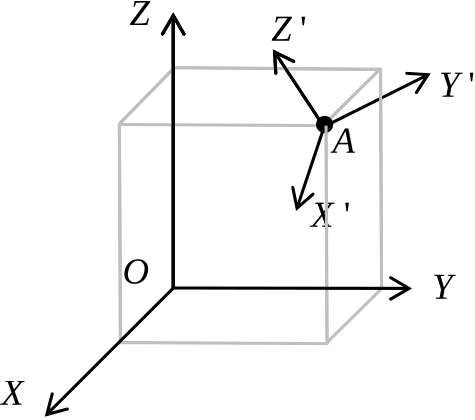
Left: an \(XY\) system in the plane. Right: a three-dimensional \(XYZ\) system with origin \(O\), and another system \(X'Y'Z'\) with origin at \(A\).
All the coordinate systems in this course are right-handed: if the fingers of the right hand curl from \(X\) towards \(Y\), the thumb points along \(Z\).
Vectors#
A vector quantity has a magnitude (size) and a direction in space. Physical quantities that are vectors (position, velocity, force, torque, angular velocity, …) must not be confused with scalars (kinetic energy, the magnitude of a velocity, the magnitude of a force, …).
A vector can be given either by its magnitude and direction separately, or by its coordinates. In print, vectors are usually written in bold (\(\mathbf{r}\)); by hand, with an arrow (\(\vec{r}\)). When vectors are operated together with matrices, they are treated as column vectors:
where the last form is the most common one, to save space.
The magnitude of a vector is written \(|\vec{r}|\) (or simply \(r\) when there is no ambiguity) and follows from its coordinates:
A unit vector has magnitude one. The unit vectors along the positive \(X\), \(Y\) and \(Z\) axes are written \(\hat{i}\), \(\hat{j}\) and \(\hat{k}\). A unit vector along any vector \(\vec{r}\) is obtained by dividing it by its magnitude:
Basic vector operations#
Addition#
The sum of two vectors is the vector whose coordinates are the sums of their coordinates:
Graphically, vectors are added by placing them tip to tail: the result goes from the tail of the first vector to the tip of the last one. Addition is commutative (\(\vec{a} + \vec{b} = \vec{b} + \vec{a}\)), so the order does not matter. This is the operation behind every velocity and acceleration polygon in this lesson.
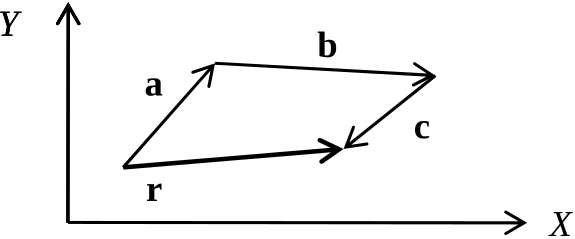
Graphical addition \(\vec{r} = \vec{a} + \vec{b} + \vec{c}\).
Subtraction#
Subtracting a vector is adding its opposite, \(\vec{r} = \vec{a} - \vec{b} = \vec{a} + (-\vec{b})\), where \(-\vec{b}\) has all its coordinates with the opposite sign or, graphically, the same magnitude as \(\vec{b}\), parallel to it, but with the opposite sense.
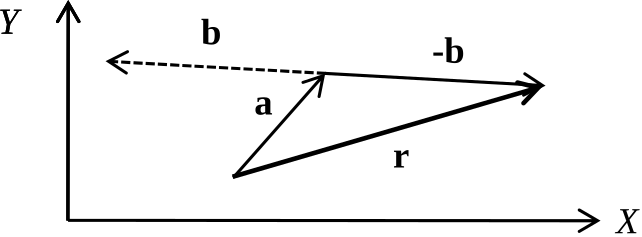
Graphical subtraction \(\vec{r} = \vec{a} - \vec{b}\).
Scaling#
Multiplying a vector by a scalar \(a\) multiplies each of its coordinates, changing its magnitude while keeping it parallel to the original (a negative scalar also reverses its sense):
This is precisely what giving a vector by its coordinates means: the three numbers scale the unit vectors \(\hat{i}\), \(\hat{j}\) and \(\hat{k}\), and the vector is the sum of the three scaled vectors. For example:
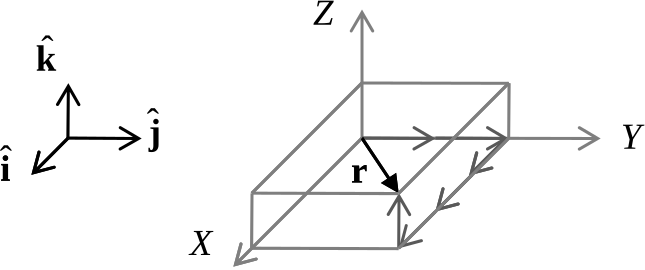
A vector built as the sum of the three unit vectors, each scaled by a different number.
Dot product#
The dot (scalar) product of two vectors \(\vec{r}_1 = (x_1, y_1, z_1)\) and \(\vec{r}_2 = (x_2, y_2, z_2)\) is the scalar:
which can also be written in a form with a clear geometric meaning:
where \(\theta\) is the angle between both vectors, measured on the plane that contains them. Two consequences are used again and again:
Two nonzero vectors are perpendicular if and only if their dot product is zero.
The dot product of a vector \(\vec{r}\) with a unit vector \(\hat{u}\), \(\vec{r} \cdot \hat{u} = |\vec{r}| \cos\theta\), is the projection of \(\vec{r}\) on the direction of \(\hat{u}\): “how much of \(\hat{u}\)” there is in \(\vec{r}\).
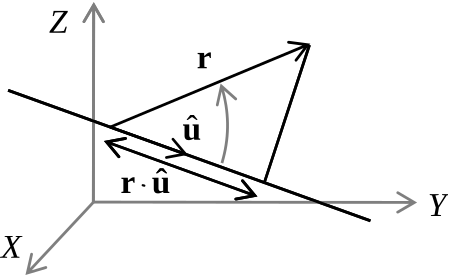
Projection of \(\vec{r}\) on the direction of \(\hat{u}\).
Cross product#
Unlike the dot product, the result of a cross (vector) product \(\vec{r} = \vec{r}_1 \times \vec{r}_2\) is a vector. Some texts write it as \(\vec{r}_1 \wedge \vec{r}_2\). Its properties are:
Its magnitude is \(|\vec{r}_1|\,|\vec{r}_2| \sin\theta\), where \(\theta\) is the angle between both vectors. Hence, the cross product of two parallel vectors (\(0^\circ\) or \(180^\circ\)) is zero.
Its direction is always perpendicular to both \(\vec{r}_1\) and \(\vec{r}_2\), that is, perpendicular to the plane they define.
Its sense is given by the right-hand rule or, equivalently, by the screw rule (see the figure below).
The order matters: \(\vec{r}_1 \times \vec{r}_2 = -\vec{r}_2 \times \vec{r}_1\). Swapping the factors gives a vector with the same magnitude and line of action but the opposite sense.
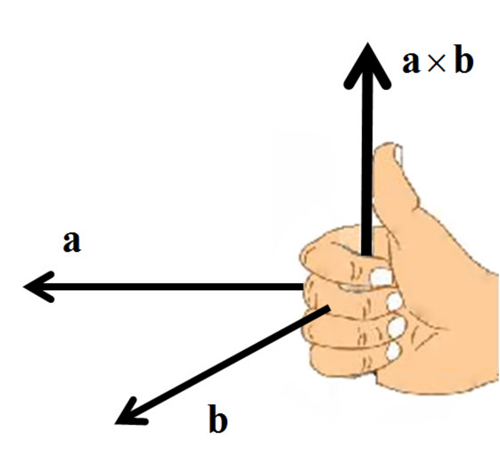
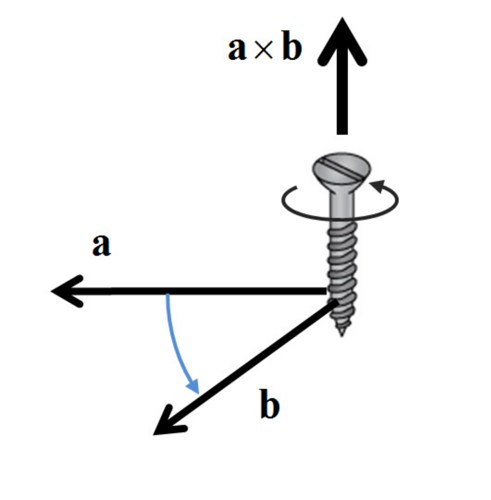
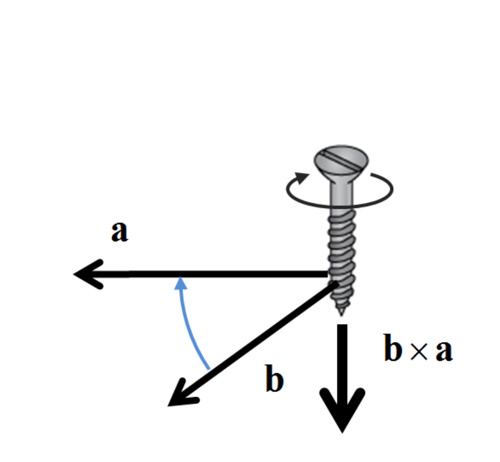
Rules for the sense of a cross product. Left: curling the fingers of the right hand from \(\vec{a}\) towards \(\vec{b}\), the thumb points along \(\vec{a} \times \vec{b}\). Center and right: a screw turned the short way from the first vector towards the second advances in the sense of the product.
Given the coordinates of both vectors, the cross product is computed with the determinant of a \(3 \times 3\) matrix:
Alternatively, the first vector can be turned into a \(3 \times 3\) skew-symmetric matrix \([\vec{r}_1]_\times\), which then multiplies the second one as an ordinary matrix product (this is how cross products are usually implemented in software):
It is worth becoming fluent with cross products of the unit vectors, since they appear in almost every problem. In a right-handed system:
A simple rule to remember them: going around the cycle \(\hat{i} \rightarrow \hat{j} \rightarrow \hat{k} \rightarrow \hat{i} \rightarrow \cdots\), the product of two consecutive vectors in this order is the next one, with a positive sign; in reverse order, the sign is negative.
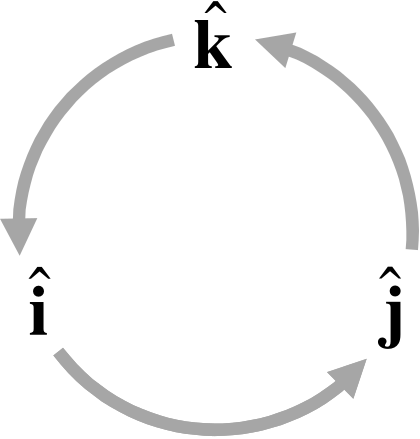
In planar kinematics, where angular velocities are always along \(\hat{k}\), the most frequent products are \(\hat{k} \times \hat{i} = \hat{j}\) and \(\hat{k} \times \hat{j} = -\hat{i}\). For any vector \(\vec{r} = x\,\hat{i} + y\,\hat{j}\) in the plane:
that is, multiplying by \(\omega\,\hat{k}\) rotates a planar vector \(90^\circ\) counterclockwise and scales it by \(\omega\) (if \(\omega < 0\) the result points the other way, as if rotated clockwise).
Vector triple product#
Triple products are just two chained cross products:
The parentheses indicate the order of the products: first \(\vec{b} \times \vec{c}\), then \(\vec{a}\) times the result. Since the cross product is not associative, in general \(\vec{a} \times (\vec{b} \times \vec{c}) \neq (\vec{a} \times \vec{b}) \times \vec{c}\).
These products appear in every normal (centripetal) acceleration, so the following shortcuts save a lot of time:
If the first and second vectors are the same unit vector and it is perpendicular to the third (also unit) vector, the result is the third vector with its sense reversed. For example:
\[ \hat{i} \times (\hat{i} \times \hat{j}) = -\hat{j}, \qquad \hat{i} \times (\hat{i} \times \hat{k}) = -\hat{k}, \qquad \hat{k} \times (\hat{k} \times \hat{i}) = -\hat{i}, \qquad \hat{k} \times (\hat{k} \times (-\hat{i})) = \hat{i} \]Writing each vector as its magnitude times a unit vector (\(\vec{a} = a\,\hat{a}\), …), the magnitudes can be taken out of the product:
\[ \vec{a} \times (\vec{b} \times \vec{c}) = a\,b\,c\, \left( \hat{a} \times (\hat{b} \times \hat{c}) \right) \]Combining both properties, for any \(\vec{a}\) perpendicular to \(\vec{b}\):
\[ \vec{a} \times (\vec{a} \times \vec{b}) = a^2\,b\,(-\hat{b}) = -a^2\,\vec{b} \]For example, \(5\,\hat{k} \times (5\,\hat{k} \times 4\,\hat{i}) = 5^2 \cdot 4\,(-\hat{i}) = -100\,\hat{i}\).
In planar kinematics this last rule reads \(\vec{\omega} \times (\vec{\omega} \times \vec{r}) = -\omega^2\,\vec{r}\), the normal acceleration of a point rotating about another one.
Derivatives of vector expressions#
Velocities and accelerations are time derivatives of position vectors. The derivative of a vector is the vector of the derivatives of its coordinates, but in practice the following rules make calculations much faster:
Linearity. The derivative of a sum is the sum of the derivatives, and constants can be taken out of the derivative:
\[ \frac{d}{dt}(\vec{a} + \vec{b}) = \dot{\vec{a}} + \dot{\vec{b}}, \qquad \frac{d}{dt}(k\,\vec{a}) = k\,\dot{\vec{a}} \quad \text{(only if $k$ is constant)} \]Product rule. As for scalar functions, \(\frac{d}{dt}(f g) = \dot{f} g + f \dot{g}\). The same rule applies to a scalar function times a vector, and to dot and cross products (keeping the order of the factors in the cross product):
\[ \frac{d}{dt}\big(k(t)\,\vec{a}\big) = \dot{k}\,\vec{a} + k\,\dot{\vec{a}}, \qquad \frac{d}{dt}(\vec{a} \cdot \vec{b}) = \dot{\vec{a}} \cdot \vec{b} + \vec{a} \cdot \dot{\vec{b}}, \qquad \frac{d}{dt}(\vec{a} \times \vec{b}) = \dot{\vec{a}} \times \vec{b} + \vec{a} \times \dot{\vec{b}} \]
The next page applies these rules to obtain all the velocity and acceleration formulas of the lesson.
Worked examples#
Example 1. Find the angle between the vectors \(\vec{r}_1 = (2, -3, 5)\) and \(\vec{r}_2 = (-1, 1, 2)\).
Solution
From the coordinates of both vectors, their dot product is:
and their magnitudes are \(|\vec{r}_1| = \sqrt{2^2 + (-3)^2 + 5^2} = \sqrt{38}\) and \(|\vec{r}_2| = \sqrt{(-1)^2 + 1^2 + 2^2} = \sqrt{6}\). Substituting into the geometric form of the dot product and solving for the angle:
Example 2. Evaluate the triple product \(10\,\hat{i} \times (10\,\hat{i} \times 3\,\hat{k})\).
Solution
Method 1. Apply the determinant formula twice, first to the product inside the parentheses:
and then to the outer product:
Method 2. Using the \(\hat{i} \rightarrow \hat{j} \rightarrow \hat{k}\) cycle: \(\hat{i} \times \hat{k}\) goes against the cycle, so it is \(-\hat{j}\), and \(10\,\hat{i} \times 3\,\hat{k} = -30\,\hat{j}\). Next, \(\hat{i} \times \hat{j} = \hat{k}\), so \(10\,\hat{i} \times (-30\,\hat{j}) = -300\,\hat{k}\). It is a good exercise to repeat this reasoning visualizing the vectors in space and checking each sense with the right-hand rule.
Method 3. The first and second vectors are the same, and perpendicular to the third one, so the triple product shortcut applies directly:
Example 3. Evaluate the triple product \(5\,\hat{i} \times (4\,\hat{j} \times 2\,\hat{k})\) and interpret the result geometrically.
Solution
The inner product is \(4\,\hat{j} \times 2\,\hat{k} = 8\,(\hat{j} \times \hat{k}) = 8\,\hat{i}\), so:
The inner cross product is perpendicular to the plane of \(\hat{j}\) and \(\hat{k}\), so it is parallel to \(\hat{i}\), and the cross product of two parallel vectors is zero. In general, \(\vec{a} \times (\vec{b} \times \vec{c}) = \vec{0}\) whenever \(\vec{a}\) is perpendicular to the plane defined by \(\vec{b}\) and \(\vec{c}\).