
Example 3.8: Bar clamp (friction locking)#
The figure shows the friction-based mechanism by which a bar clamp locks and prevents its arm from sliding along the bar. Dry friction is assumed at both contact points, and the normal force \(N\) is the same at both.
Determine the maximum width \(e\) of the arm that ensures clamping without sliding, for a friction coefficient \(\mu = 0.20\) between the bar and the arm. Data: \(l = 80\) mm, \(b = 20\) mm.
Hint: find the maximum value of \(e\) from the force equilibrium in the case where the friction force is exactly at its maximum possible value.
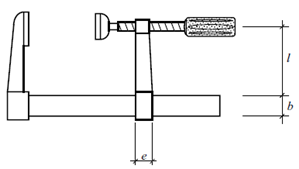
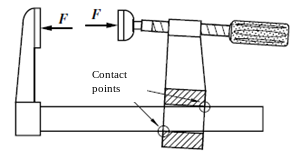
(Exam of January 2023.)
Solution
We write the equilibrium of the moving arm of the clamp. When tightening, the workpiece exerts a horizontal force \(F\) on the arm (to the right in the figure), at a distance \(l\) above the bar. The slightly tilted arm touches the bar at two points: \(A\), on the top face of the bar, and \(B\), on the bottom face. At each of them there are a normal force \(N\) and a friction force \(R\), which opposes the sliding that \(F\) would cause:
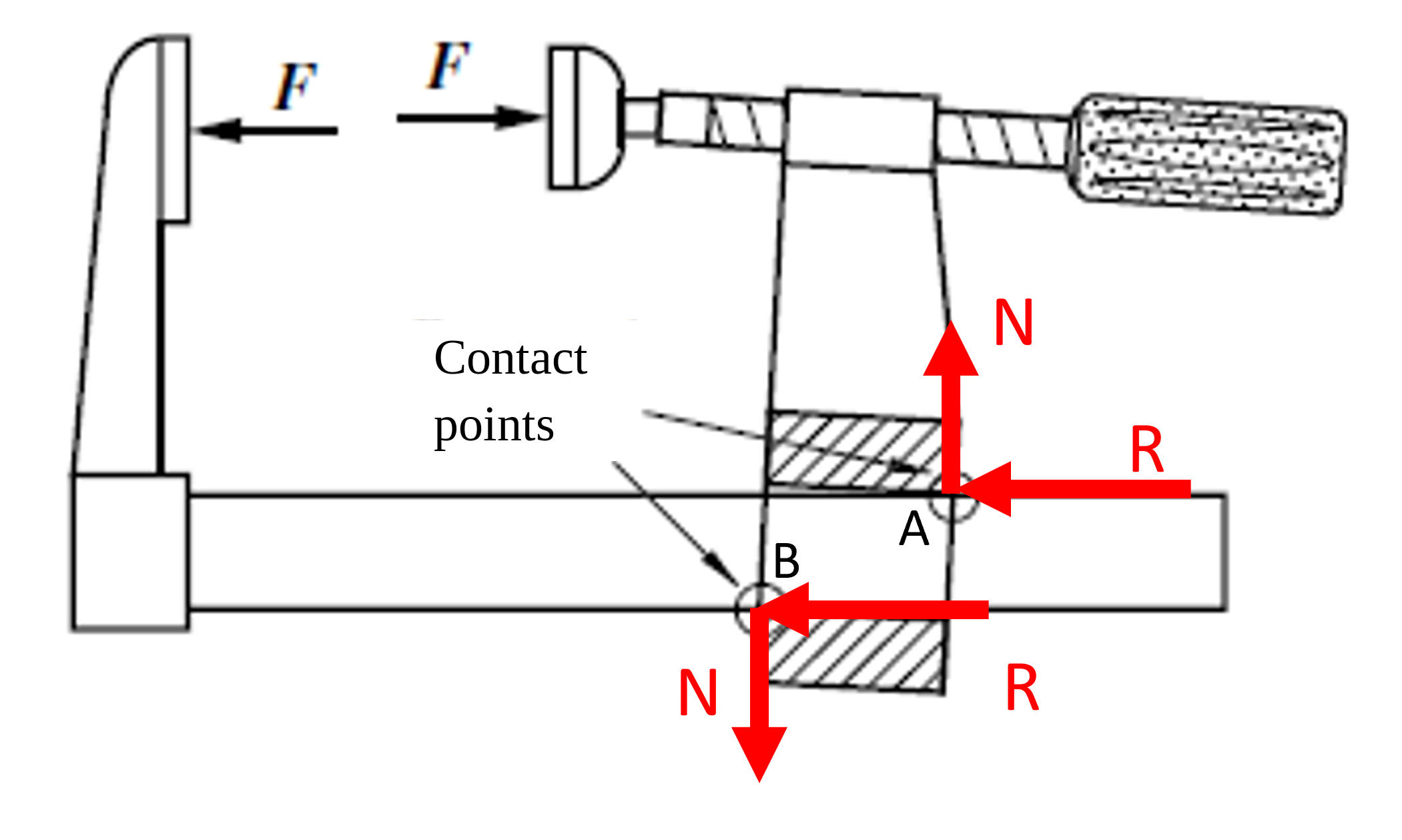
Since we look for the limit case, instead of Coulomb’s inequality \(R \le \mu N\) we use its maximum value, \(R = \mu N\). The equations of statics are:
Substituting \(R = F/2\) and \(N = F/(2\mu)\) into the moment equation:
The force \(F\) cancels out: the result does not depend on how hard the clamp is tightened. It is a self-locking mechanism: if the arm is narrow enough, it never slides, however large \(F\) is. Numerically:
For \(e < 36\) mm, the moment created by \(F\) forces \(N\) to grow enough for the maximum friction \(2\mu N\) to exceed \(F\), and the arm does not slide.
Check taking moments about \(B\). The result does not depend on the chosen point: