
Computing inertias in 2D#
Even in the simplest planar problems we need the moment of inertia \(I_{z,G}\) of each link. This page shows how to compute it for the most common links of a mechanism.
Definition#
The moment of inertia of a planar body about the \(z\) axis through a point \(P\) is:
where \((x', y')\) are the coordinates of each element \(dm\) relative to \(P\), and \(r'\) its distance to the axis.
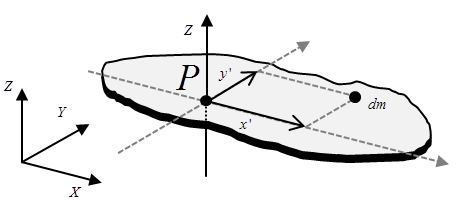
It measures how much mass is far from the axis: the larger it is, the more torque is needed to change the rotation of the body. Its units are kg·m². The reference point will normally be the center of mass \(G\) (in numerical methods this is not always the case).
This formula always works, but computing it is tedious. In practice, a few common cases are memorized and combined with the tools below.
What is the mass differential \(dm\)?#
Planar link (2D): \(dm = \rho(x', y')\, dx'\, dy'\), with \(\rho\) the surface density. For total mass \(M\), area \(A\) and uniform density: \(dm = \frac{M}{A}\, dx'\, dy'\).
Approximately linear link (1D): if the link is much longer than it is wide and thick, its mass is assumed to be distributed only along its axis (for instance, \(x'\)) and the other dimension is ignored: \(dm = \rho(x')\, dx'\). For mass \(M\), length \(L\) and uniform density: \(dm = \frac{M}{L}\, dx'\).
Tools#
Steiner’s (parallel axis) theorem#
Given the moment \(I_{z,G}\) about the center of mass \(G\), the moment about a parallel axis through another point \(P\) is:
where \(M\) is the total mass and \(d = |PG|\) the distance between both axes.
As a consequence, the moment of inertia is minimum about an axis through \(G\). The theorem can only be applied starting from \(G\) (or to go back to \(G\)); to move between two arbitrary points \(P\) and \(Q\), one must go through \(G\): \(I_Q = I_P - M\,|PG|^2 + M\,|QG|^2\).
Composition: addition and subtraction#
As long as all moments of inertia are taken about the same axis and the same point, the moments of the parts of a composite body can be added:
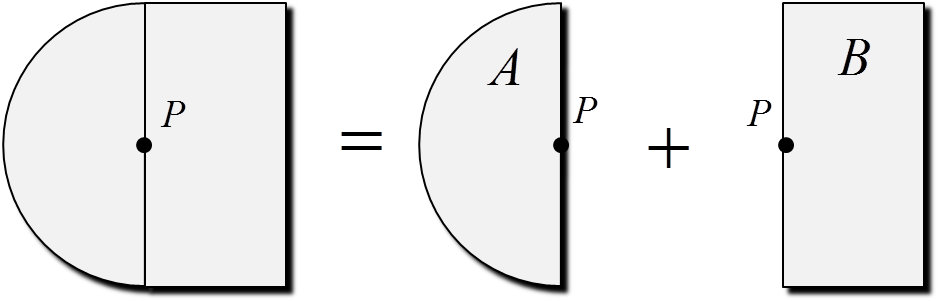
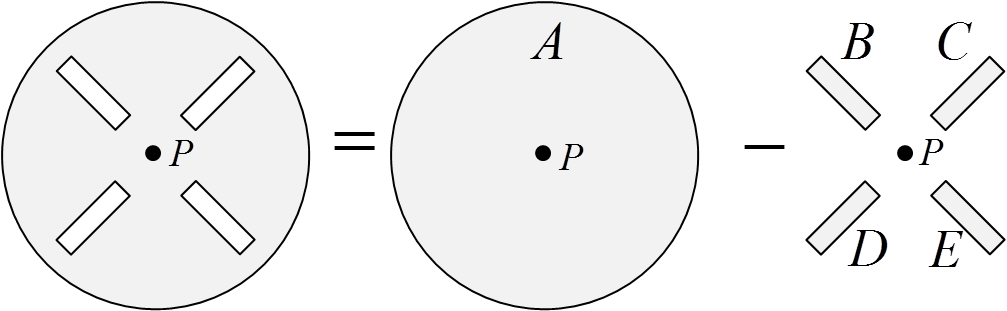
And those of holes, subtracted:
Common cases#
Point mass#
A massless string or rod with a mass \(M\) at its end, at a distance \(d\) from \(P\):
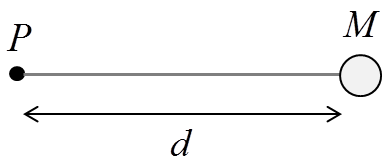
(It can be proven, for instance, using a Dirac delta as density.) Food for thought: what happens if moments are taken about the very point where the mass is?
Slender bar#
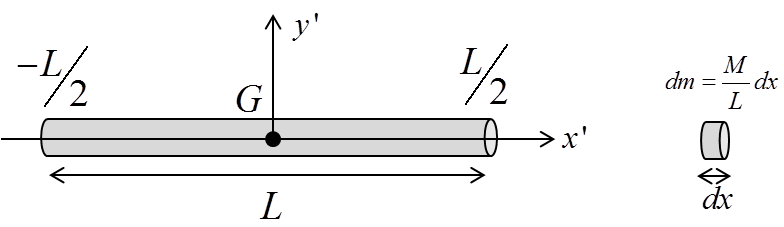
Bar of length \(L\) and uniform mass \(M\), much longer than it is thick, about its center of mass:
Proof
With the 1D model, \(dm = \frac{M}{L}dx'\) and \(y' \approx 0\):
About one end, by Steiner’s theorem with \(d = L/2\): \(I_{z,\text{end}} = \frac{1}{12}ML^2 + M\frac{L^2}{4} = \frac{1}{3}ML^2\).
Solid disk or cylinder#
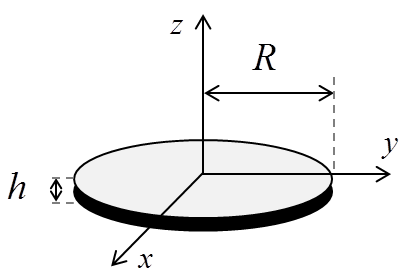
Disk of radius \(R\) and uniform mass \(M\), about its center:
Proof
The disk is split into rings of radius \(r\) and width \(dr\), with area \(2\pi r\,dr\), so \(dm = \frac{M}{\pi R^2}\, 2\pi r\, dr\). All points of a ring are at a distance \(r\) from the axis:
Summary table#
Link |
\(I_{z,G}\) |
|---|---|
Point mass at distance \(d\) (about the axis) |
\(M d^2\) |
Slender bar of length \(L\) |
\(\frac{1}{12} M L^2\) |
Slender bar, about one end |
\(\frac{1}{3} M L^2\) |
Rectangular plate \(a \times b\) |
\(\frac{1}{12} M \left(a^2 + b^2\right)\) |
Solid disk or cylinder of radius \(R\) |
\(\frac{1}{2} M R^2\) |
Thin ring or tube of radius \(R\) |
\(M R^2\) |
Hollow cylinder with radii \(R_1\) and \(R_2\) |
\(\frac{1}{2} M \left(R_1^2 + R_2^2\right)\) |
Solid sphere (about a diameter) |
\(\frac{2}{5} M R^2\) |
Thin hollow sphere (about a diameter) |
\(\frac{2}{3} M R^2\) |
Sometimes the radius of gyration \(k\) is given instead, defined by \(I_{z,G} = M k^2\): it is the distance at which all the mass would have to be concentrated to get the same inertia.
Example: plate with a hole#
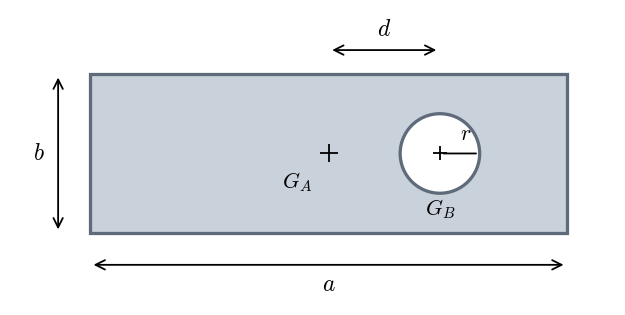
A steel plate (\(\rho = 7850\) kg/m³) of \(a \times b = 300 \times 100\) mm and thickness \(t = 10\) mm has a hole of radius \(r = 25\) mm, whose center \(G_B\) is at \(d = 70\) mm from the center \(G_A\) of the plate. Compute its moment of inertia about its center of mass \(G\).
Solution
Masses. Full plate and “hole” disk:
The mass of the part is \(m = m_A - m_B = 2.2009\) kg.
Inertias about \(G_A\). Plate: \(I^A_{G_A} = \frac{1}{12} m_A (a^2+b^2) = 0.019625\) kg·m². Disk: about its center, \(\frac{1}{2} m_B r^2 = 4.82\cdot 10^{-5}\) kg·m², and about \(G_A\) by Steiner’s theorem:
Subtracting (both refer to the same point \(G_A\)): \(I_{G_A} = 0.019625 - 0.000803 = 0.018822\) kg·m².
Center of mass. The hole shifts \(G\) to the opposite side, a distance \(e\) from \(G_A\):
Inertia about \(G\). Applying Steiner’s theorem “backwards” (from \(G_A\) to \(G\)):
The correction due to the shift of \(G\) is small here (0.3 %), but it is not always so.
For complex parts, CAD software directly provides the mass, center of mass and inertia tensor from the solid model.