
Example 3.2: Disk driven by a piston#
In the mechanism of the figure, a horizontally guided piston \(P\) drives a disk through a connecting rod \(PQ\). The disk rotates about its center \(O\), and at the instant considered the pin \(Q\) is right above \(O\) and the rod is at \(45^\circ\) from the horizontal. What force \(F\) must the piston exert for the disk to have an angular acceleration of \(1000\) rpm/s clockwise?
Data: piston and rod of negligible mass; disk of mass \(M = 1\) kg and diameter \(20\) cm; rod length \(L = 40\sqrt{2}\) cm. Neglect friction.
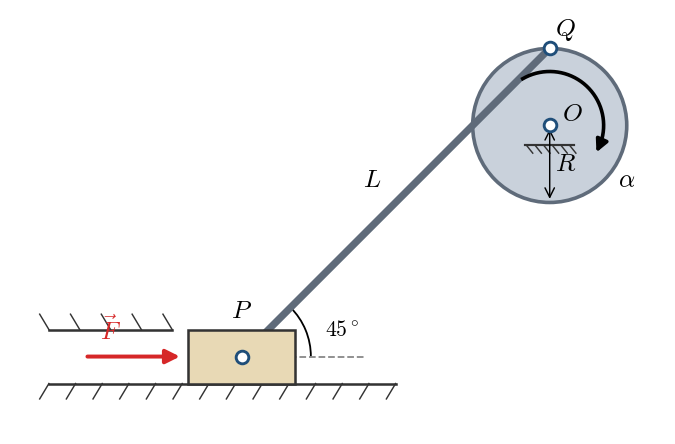
Solution
Kinematics. The angular acceleration, in SI units, is:
Inertia loads. Only the disk has mass. Since it rotates about its center of mass, \(\vec{a}_G = \vec{0}\) and there is no inertia force: just an inertia torque, opposite to \(\alpha\) (counterclockwise):
Note that this result does not depend on the angular velocity of the disk: the disk rotates about its center of mass, and the rod and piston are massless.
Rod. With no mass and no loads, it is a two-force member: the force \(F_b\) it transmits acts along \(PQ\), at \(45^\circ\).
Disk. Taking moments about \(O\) (so that the reaction at the shaft does not appear), the moment of the rod force must balance the inertia torque. The distance from \(O\) to line \(PQ\) is \(d = R \sin 45^\circ\) (the angle between \(OQ\), vertical, and the rod is \(45^\circ\)):
The rod is in compression: it pushes pin \(Q\) up and to the right, which gives a clockwise moment about \(O\), as needed to accelerate the disk clockwise.
Piston. It receives the force \(F\), the guide reaction \(N\) (vertical) and the rod force (at \(45^\circ\), downwards and to the left). Its force equilibrium gives:
Combining the expressions, \(F = I_G\,\alpha / R\): with the rod at \(45^\circ\) and the pin right above \(O\), the piston force is the same as if it acted tangentially on the rim of the disk. The rod length plays no role.
Reaction at the disk shaft. Since the disk has no inertia force, \(\vec{F}_{O} = -\vec{F}_b = -(5.24\,\hat{i} + 5.24\,\hat{j})\) N.