
Example 3.9: Two blocks joined by a bar, with friction#
In the mechanism of the figure, two identical blocks of mass \(m\) are joined by a bar of negligible mass, pinned at their centers \(G_1\) and \(G_2\). Block 1 slides on a horizontal surface and block 2 on a vertical wall. There is dry friction with coefficient \(\mu\) at the block contacts; friction at the pins is negligible. The bar is at an angle \(\varphi\) from the horizontal. Find:
The horizontal force \(F\) needed to start the motion from rest, in each direction.
Its numerical value for \(\varphi = 45^\circ\) and \(\mu = 0.2\).
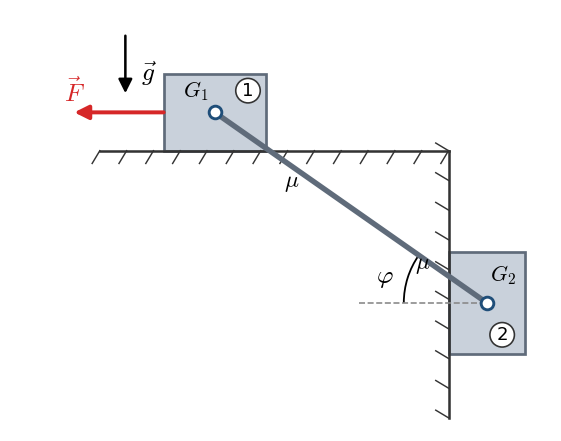
(Adapted from problem 7-1 of [CFCC01].)
Solution
Bar. Massless and pinned at its ends: it is a two-force member. Let \(T\) be the force it transmits, positive in tension. It pulls block 1 towards \(G_2\), with direction \((\cos\varphi, -\sin\varphi)\), and block 2 towards \(G_1\), with direction \((-\cos\varphi, \sin\varphi)\).
Block 2. It receives its weight \(mg\), the bar force, the normal force from the wall \(N_2\) (horizontal, to the right, since the wall is on its left) and friction \(\mu N_2\) (vertical, opposite to the motion). From horizontal equilibrium:
Block 1. It receives its weight, the bar force, the normal force from the floor \(N_1\), friction \(\mu N_1\) (horizontal, opposite to the motion) and the force \(F\). From vertical equilibrium:
At the start of motion, friction at both contacts equals \(\mu N\), with the sense opposite to the motion about to happen. There are two cases.
Case (a): \(F\) to the left; block 1 moves left and block 2 moves up. Friction on block 2 points down and on block 1, to the right:
Substituting \(T\) and dividing by \(\cos\varphi\):
This result only makes sense if \(\tan\varphi > \mu\). If \(\tan\varphi \le \mu\) (\(\varphi \le \arctan\mu = 11.3^\circ\) for \(\mu = 0.2\)), the force of the bar on block 2 falls inside its friction cone: the mechanism locks, and no force \(F\), however large, can lift block 2.
Case (b): block 1 moves right and block 2 moves down. Now the friction forces change sense:
with \(F_x\) the applied force, positive to the right. Proceeding in the same way:
If \(F_x < 0\), the weight of block 2 alone is enough to set the system in motion: to keep it at rest, it must be held with a force to the left of magnitude at least \(|F_x|\).
Numerical values (\(\varphi = 45^\circ\), \(\mu = 0.2\), \(\tan\varphi = 1\)):
That is, with no applied force block 2 falls. The system stays at rest if a force to the left \(F\) between \(0.467\,mg\) and \(1.70\,mg\) is applied; above that range, block 2 moves up, and below it, it moves down. Without friction (\(\mu = 0\)), both limits would coincide at \(F = mg/\tan\varphi = mg\): friction creates an equilibrium band instead of a single value.