
Example 3.3: Vehicle accelerating on level ground#
A vehicle of mass \(m\) accelerates on level ground with acceleration \(a\). Its center of mass \(C\) is at a height \(h\) above the ground, at a distance \(a_1\) from the front axle and \(a_2\) from the rear one (wheelbase \(L = a_1 + a_2\)). What is the vertical reaction force at each wheel? Apply it to \(m = 1500\) kg, \(a = 3\) m/s², \(a_1 = 1.2\) m, \(a_2 = 1.5\) m and \(h = 0.55\) m.
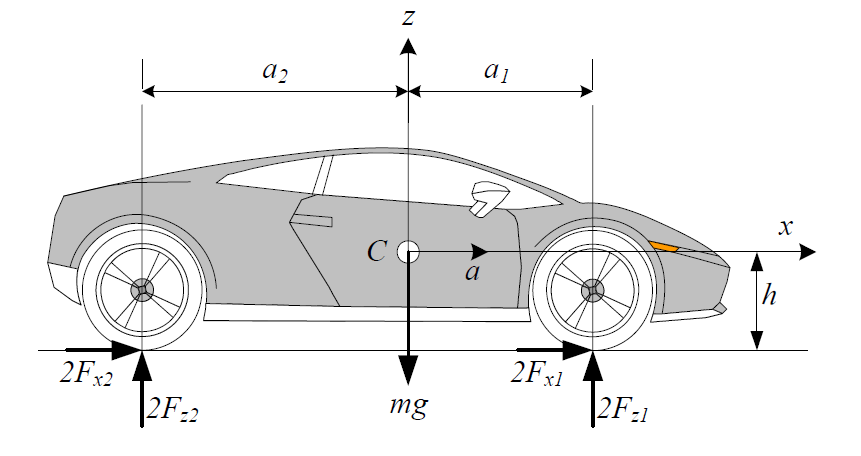
The vehicle is assumed to be symmetric, so both wheels of an axle carry the same load: \(2F_{z1}\) at the front axle and \(2F_{z2}\) at the rear one.
Solution
We study the whole vehicle as a single rigid body (the wheels rotate, but their mass is small compared with the rest, and we neglect their rotational inertia).
Inertia loads. The vehicle translates with acceleration \(a\) forwards (\(+x\)): by D’Alembert’s principle, we add an inertia force \(-m a\) backwards, applied at the center of mass \(C\).
Equilibrium. The forces on the vehicle are: the weight \(mg\) at \(C\), the vertical reactions \(2F_{z1}\) and \(2F_{z2}\) and the horizontal ones \(2F_{x1}\) and \(2F_{x2}\) at the wheel contacts, and the inertia force. The equations are:
In the moment equation, taken about the contact point of the rear wheel (counterclockwise positive), neither the rear wheel forces nor any horizontal force on the ground appear; the inertia force, with arm \(h\), does have a moment. From the third and second equations:
The first term is the static weight distribution; the second one is the load transfer due to the acceleration: when accelerating, the front axle is unloaded and the rear one is loaded (the opposite happens when braking).
Numerical application. With \(L = 2.7\) m:
The front wheels would lift off (\(F_{z1} = 0\)) at an acceleration \(a = g\,a_2/h = 26.8\) m/s², far above what a passenger car can reach. On a motorcycle, with a large \(h\) and a short \(L\), this condition is reached (a “wheelie”).
Horizontal forces. We only know that \(2F_{x1} + 2F_{x2} = m a\): how they are shared between the axles is indeterminate with the equations of statics (a hyperstatic problem). It depends on the drivetrain: in a front-wheel drive vehicle, \(F_{x2} \approx 0\) (except for rolling resistance), and in a rear-wheel drive one, \(F_{x1} \approx 0\).